

5 Best Access Control Systems for Retail Stores
Table of Contents
How Access Control Systems Protect Retail Stores
Quick Comparison Table
Key Considerations for Retail Environments
1. Brivo: Cloud-Based Management for Multi-Location Retail
2. Kisi: Mobile-First Access Control
3. Verkada: Integrated Video and Access Control
4. Avigilon Alta: Touchless Entry and Enterprise Scalability
5. Ubiquiti UniFi Access: Hardware-Focused, Subscription-Free
Access Control System Installation Costs and ROI
Shrinkage Reduction: The Primary ROI Driver for Retail
Compliance and Data Privacy Considerations
Emergency Lockdown and Active Threat Procedures
Calculating Your Retail ROI
Frequently Asked Questions
Last Updated: October 3, 2026
How Access Control Systems Protect Retail Stores
Access control systems manage who enters restricted areas, track employee movements, and create audit trails that prevent theft and unauthorized access. The right system balances security, ease of use, and integration with existing operations.

The 5 best access control systems for retail stores combine mobile credentials, real-time monitoring, video surveillance integration, and cloud-based multi-location management. Systems tailored to specific workflows reduce shrinkage and improve operational security.
When evaluating systems, consider traffic patterns, credential types, and integration with existing security infrastructure. The 5 best access control systems for retail stores below represent the strongest options for retail, each with distinct strengths.
Quick Comparison Table
System | Best For | Mobile Credentials | Cloud-Based | Hardware Durability (IP Rating) | Offline Failsafe | Multi-Location Management | Estimated Install Cost (Single Location) |
Brivo | Multi-location retailers | Yes (smartphone app) | Yes (required) | IP65 (weather-sealed readers) | Limited, cloud-dependent | Centralized dashboard for unlimited locations | $3,000-$8,000 |
Kisi | User experience prioritization | Yes (smartphone app) | Yes (required) | IP54 (standard commercial) | Limited, cloud-dependent | Centralized dashboard for unlimited locations | $2,500-$7,000 |
Verkada | High-end integrated security with video | Yes (smartphone app) | Yes (required) | IP67 (fully sealed, vandal-resistant) | Limited, cloud-dependent | Unified platform with AI analytics across all sites | $5,000-$12,000 |
Avigilon Alta | Touchless entry and enterprise scalability | Yes (smartphone app, NFC) | Yes (required) | IP67 (enterprise-grade sealed) | Limited, cloud-dependent | Centralized cloud management for enterprise deployments | $4,000-$10,000 |
Ubiquiti UniFi Access | Hardware ownership, subscription-free operation | Yes (NFC cards + app) | Optional (on-premise available) | IP65 (weather-sealed, high-cycle-rated) | Yes, operates offline with local controller | Centralized UniFi Console if on-premise | $1,500-$5,000 |
Key Considerations for Retail Environments
Hardware Durability: Retail doors experience 500+ cycles per day. IP65 and IP67 ratings indicate sealed electronics resistant to moisture, dust, and vandalism. Ubiquiti UniFi Access and Verkada are rated for high-cycle doors; IP54 readers (Kisi) may require more frequent maintenance.
Offline Failsafe: Cloud-dependent systems lose functionality during outages. Ubiquiti UniFi Access with local controllers maintains access control if connectivity drops. Cloud-only systems should have redundant internet (primary broadband + cellular backup).
Credential Type: Mobile app credentials suit younger workforces and reduce key management. NFC cards work for diverse staff or those uncomfortable with smartphones. Brivo and Kisi are mobile-first; Ubiquiti supports both.
Subscription Model: Brivo, Kisi, Verkada, and Avigilon Alta charge $20-$100+ per door annually. Ubiquiti UniFi Access has no recurring software costs, making it cost-effective for retailers with tight margins or multiple locations.
1. Brivo: Cloud-Based Management for Multi-Location Retail
Brivo delivers cloud-based access control for multi-location retailers, centralizing credential management across all sites from a single dashboard.
The system supports mobile credentials via smartphone apps and integrates with video surveillance, creating a unified view to correlate access events with footage during incident investigations.
Real-time audit trails document access attempts and denials. Role-based permissions grant different access levels to managers, staff, and vendors based on responsibilities.
Brivo requires professional installation and cloud connectivity. It scales from five to hundreds of locations, suitable for growing retail chains.
Pro Tip Brivo's mobile credential feature reduces the operational friction of managing physical keys across store locations. Staff can receive access permissions instantly when hired, without waiting for physical key production.
2. Kisi: Mobile-First Access Control
Kisi prioritizes user experience with mobile-first design. Employees unlock doors via smartphones, and the app integrates with Slack and Google Workspace for access requests and approvals.
Remote door unlocking allows managers to grant temporary access to delivery personnel or contractors. Activity logs track every access event with timestamps and user identification.
Kisi reduces friction for employees while maintaining oversight. The intuitive interface requires minimal training, and integration with business tools saves administrative time in high-turnover retail environments.
Hardware costs accumulate across locations, and subscription fees add ongoing expenses. Many retailers find operational efficiency gains justify the investment.
Best For Retail stores with younger workforces comfortable using smartphones for daily operations, or locations where frequent temporary access is needed.
3. Verkada: Integrated Video and Access Control
Verkada combines access control with AI-powered video analytics on a unified cloud platform, showing who accessed locations and what they did.
AI analytics detect unusual patterns like repeated access attempts at odd hours. Automatic firmware updates keep security infrastructure current without manual intervention.
Verkada's strength is the integrated approach: instead of managing separate systems for access and video, you operate one cohesive platform. Global search functionality lets you query across all connected sites simultaneously, which proves valuable for multi-location retailers investigating incidents.
The premium pricing reflects the advanced capabilities and integrated architecture. Retailers requiring high-end security with sophisticated analytics justify the cost through reduced loss and faster incident response. For smaller retailers, the expense may exceed the perceived benefit.

4. Avigilon Alta: Touchless Entry and Enterprise Scalability
Avigilon Alta, built by Motorola Solutions, emphasizes touchless mobile access and cloud-native architecture. The system issues digital credentials through mobile apps, allowing employees to unlock doors without touching physical readers, a capability that gained prominence during health-conscious operational periods.
The open API enables custom integrations with third-party systems, allowing retailers to connect access control with inventory management, time and attendance, or other operational tools.
Avigilon Alta prioritizes cybersecurity with encryption throughout the system and regular security updates. For retailers handling sensitive employee or customer data, this focus on data protection aligns with modern compliance expectations.
The system requires reliable internet connectivity. Retailers in areas with inconsistent connectivity should evaluate whether cloud-only architecture fits their operational needs. Enterprise features may exceed the requirements of single-location retailers, making it most suitable for growing chains.
Watch Out Cloud-dependent systems lose functionality during internet outages. Ensure your retail locations have redundant internet connections if you choose a cloud-only platform.
5. Ubiquiti UniFi Access: Hardware-Focused, Subscription-Free
Ubiquiti UniFi Access takes a different approach: you purchase hardware once and operate it without recurring software subscriptions.
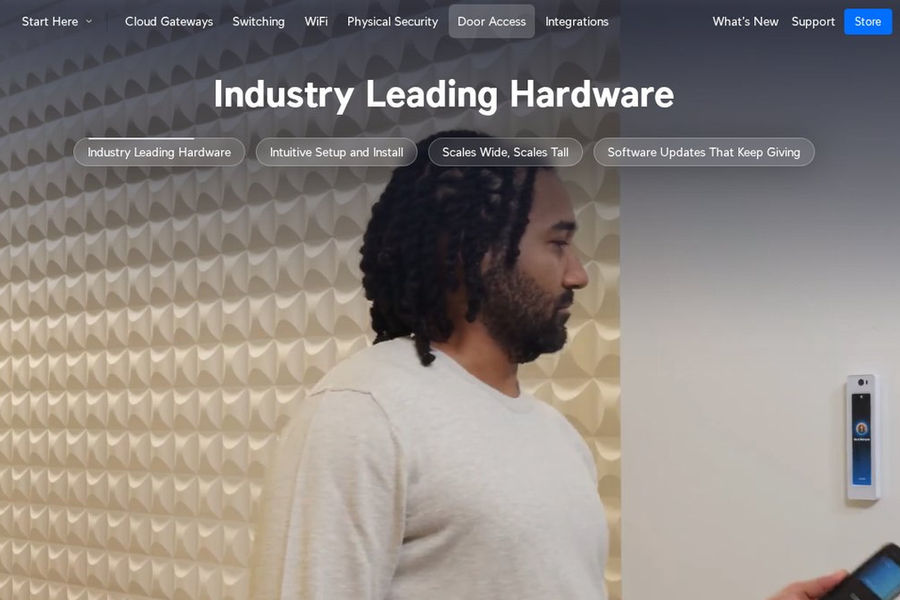
The platform includes integrated video intercom capabilities, allowing staff to screen visitors or delivery personnel before granting entry. Centralized management through UniFi Console provides a single pane of glass for all access and network equipment.
The primary advantage is ownership: once you've purchased the hardware, there are no monthly software fees. For retailers operating on tight margins or managing multiple locations, eliminating recurring costs can be significant.
Ubiquiti UniFi Access lacks some advanced enterprise features found in cloud-based competitors. Reporting capabilities are more basic, and integration options are limited compared to platforms with extensive APIs. For straightforward access control without sophisticated analytics, this represents good value.
Access Control System Installation Costs and ROI
Installation costs for access control systems vary significantly based on system choice, number of doors, and existing infrastructure. Cloud-based systems typically require professional installation to ensure proper configuration and integration, ranging from $2,000 to $15,000 for a single retail location depending on door count and complexity. Hardware-focused systems like Ubiquiti may allow for simpler self-installation in some cases, though professional installation remains recommended for optimal performance and compliance.
Shrinkage Reduction: The Primary ROI Driver for Retail
Retail shrinkage, the difference between recorded and actual inventory, averages 1.62% of sales according to loss prevention industry benchmarks. Access control systems address the employee-theft component of shrinkage, which represents approximately 30-40% of total loss. By restricting access to stockrooms, receiving areas, and high-value merchandise zones, you create accountability barriers that deter unauthorized removal.
The mechanism is straightforward: detailed access logs create an audit trail. When a stockroom door is accessed at 11 p.m. by a part-time employee, or when a manager enters the receiving area outside scheduled hours, the system records timestamp, user identity, and duration.
For a mid-sized retail store with $2 million in annual sales and 1.62% shrinkage ($32,400 annual loss), reducing shrinkage by just 0.3 percentage points through access control ($6,000 recovered) pays for a $5,000 system installation in year one.
Compliance and Data Privacy Considerations
Access logs are employment records under the Fair Labor Standards Act and must be retained according to your state's labor record retention requirements, typically 3 to 7 years depending on jurisdiction. These logs can become evidence in wage-and-hour disputes, theft investigations, or workers' compensation claims, making data integrity and security critical.
Retailers must also comply with state privacy laws. California's Consumer Privacy Act (CCPA) and similar state regulations increasingly govern how employee location and movement data is collected, stored, and shared. Access logs that identify employees by name, time, and location constitute personal information under these frameworks.
When selecting a system, verify that the vendor:
Encrypts access logs both in transit and at rest
Provides audit trails showing who accessed the access control system itself (preventing unauthorized log deletion)
Supports data retention policies so you can automatically purge logs after your required retention period
Complies with state privacy laws in your operating regions
Cloud-based systems like Brivo and Avigilon Alta publish security certifications (SOC 2 Type II compliance) that demonstrate third-party verification of data handling practices. On-premise systems like Ubiquiti UniFi Access give you direct control over data storage but require your IT team to manage encryption and backup security.
Emergency Lockdown and Active Threat Procedures
Access control systems enable rapid response to active threats in retail environments. When a security incident occurs, whether an active threat, civil unrest, or medical emergency, managers need the ability to lock down specific zones instantly without physically running to each door.
Systems with remote unlock/lock capabilities (Brivo, Kisi, Avigilon Alta) allow a manager or security officer to lock all exterior doors and restrict movement between zones from a mobile app or dashboard. This prevents unauthorized entry and controls employee and customer movement during an emergency. The access logs then document exactly who was in each zone when the lockdown occurred, aiding emergency responders and post-incident investigation.
When evaluating systems, confirm they support:
One-touch lockdown of all doors or specific zones
Mobile app access for remote triggering (not just desktop dashboard)
Integration with panic buttons or emergency alert systems
Failsafe behavior: doors default to locked if power or connectivity is lost
Calculating Your Retail ROI
Calculate potential ROI by estimating:
Current shrinkage rate (annual inventory loss ÷ annual sales)
Access-control-preventable portion (typically 20-35% of employee-theft component)
Administrative time savings from eliminating physical key management (estimate hours per month × hourly labor cost)
System cost (installation + hardware + 3-year subscription fees if applicable)
For most retail operations, the payback period ranges from 6 months to 2 years depending on store size, shrinkage severity, and system choice. A single-location store with $1 million in sales and 1.5% shrinkage might recover $3,000 annually; a 10-location chain could recover $30,000 to $50,000 annually when accounting for both shrinkage reduction and administrative efficiency.
Frequently Asked Questions
What is the best access control system for a retail store?
The best system depends on your store size and needs. Cloud-based systems like Brivo work well for multi-location retailers needing remote management. Mobile-first options like Kisi suit stores prioritizing employee experience. Integrated platforms like Verkada combine video and access control, reducing shrinkage through unified monitoring. For small retailers already using UniFi networking, Ubiquiti offers hardware without recurring software fees. Bay Safe and Lock can assess your specific requirements and recommend the right fit.
How do cloud-based access control systems benefit retail stores?
Cloud-based systems provide real-time monitoring and remote management from anywhere, enabling managers to grant or revoke access instantly. They generate detailed entry logs for compliance and loss prevention audits. Scalability is built in, so adding new locations or doors requires minimal infrastructure investment. Integration with video surveillance and visitor management systems creates a unified security picture. Most support mobile credentials, reducing key card costs and improving employee convenience while strengthening credential management and perimeter security.
What should I look for when choosing an access control system for retail loss prevention?
Prioritize systems offering real-time activity logs and audit trails to track who accessed restricted areas and when. Look for role-based access control to limit employee permissions to necessary areas only, reducing internal shrinkage. Integrated video surveillance helps verify access events and identify suspicious behavior. Touchless entry and biometric authentication prevent unauthorized key duplication. Emergency lockdown protocols are essential for safety. Hardware must withstand high-traffic wear in retail environments. Bay Safe and Lock can help identify features that directly address your specific shrinkage concerns.
How much does access control system installation cost for retail stores?
Costs vary widely based on store size, number of doors, hardware choices, and integration requirements. Small single-location stores typically invest less than large multi-site chains. Cloud-based systems often include subscription fees beyond hardware costs. Hardware-only systems like Ubiquiti have lower ongoing costs but may require networking expertise. Installation complexity affects labor costs significantly. For an accurate estimate tailored to your retail environment, contact Bay Safe and Lock for a consultation and detailed quote.
NEED AN ESTIMATE FOR YOUR PROJECT? CLICK HERE


Comments