

How to Choose Commercial Locks: A 2026 Guide
Updated: Sep 16
Table of Contents
Why Choosing the Right Commercial Locks Matters
ANSI/BHMA Lock Grades Explained
Grade 1 vs. Grade 2 vs. Grade 3
BHMA Certification and What It Means
Commercial Door Hardware Types
Mortise Locks vs. Cylindrical Locks
Exit Devices and Panic Bars
Deadbolts and Strike Plates
Fire-Rated Door Hardware Requirements
Access Control System Integration
Keyless Entry and Biometric Authentication
Master Key Systems and Credential Management
Cybersecurity Considerations for Smart Locks
Key Factors to Consider When Selecting Commercial Locks
Traffic Volume and Durability
Material and Weather Resistance
ADA Compliance and Accessibility
Total Cost of Ownership
Common Mistakes to Avoid
Conclusion
Last Updated: August 26, 2026
Why Choosing the Right Commercial Locks Matters
Selecting appropriate commercial locks shapes your facility's security posture, regulatory compliance, operational efficiency, and long-term costs. Poorly chosen systems create vulnerabilities, repeated rekeying, incompatible hardware, and replacement expenses that dwarf the original investment.
At Bay Safe and Lock, we've worked with facility managers, property owners, and business operators across diverse industries. Teams that invest upfront in understanding lock grades, hardware types, and integration requirements avoid costly mistakes. The stakes vary by property type, a retail storefront faces different threats than a medical facility or industrial warehouse, yet the fundamental framework remains the same: match your lock system to your specific traffic volume, security requirements, compliance obligations, and integration needs.
Pro Tip The most expensive lock system isn't always the best choice. The right system matches your specific facility's traffic patterns, security threats, and integration requirements. Oversizing creates unnecessary costs; undersizing creates security gaps.
ANSI/BHMA Lock Grades Explained
The ANSI/BHMA grading system is the foundation of commercial lock selection in the United States. These standards define how locks perform under specific stress conditions and establish a common language between security professionals, installers, and facility managers.
ANSI Grade 1 is the highest security classification. These locks undergo 1 million cycles of operation, 10 minutes of direct force application, and multiple picking attempts. Grade 1 locks are built for high-traffic environments where security is paramount: banks, government facilities, medical centers with restricted areas, and industrial sites handling sensitive materials.
ANSI Grade 2 handles 500,000 operational cycles and is designed for moderate to heavy commercial traffic. Most office buildings, retail stores, apartment complexes, and medical facilities operate successfully with Grade 2 hardware. Grade 2 locks balance durability, security, and affordability, making them the most common choice for general commercial applications.
ANSI Grade 3 supports 100,000 cycles and is suitable for light commercial use or areas with lower security requirements. Grade 3 is rarely the right choice for primary entrances or spaces requiring genuine security.
Grade 1 vs. Grade 2 vs. Grade 3
Grade | Cycle Rating | Force Resistance | Best For | Typical Cost Impact |
Grade 1 | 1,000,000 | 10 min direct force | Banks, government, restricted medical areas | Highest |
Grade 2 | 500,000 | Moderate force | Offices, retail, apartment complexes, standard medical facilities | Moderate |
Grade 3 | 100,000 | Light force | Secondary doors, storage, low-traffic areas | Lowest |
For most commercial properties, the decision comes down to Grade 1 versus Grade 2. Grade 1 is necessary when your facility has high-value assets, restricted access zones, or regulatory requirements that mandate the highest security level. Grade 2 is sufficient for most general commercial applications.
Watch Out Choosing Grade 3 for a primary entrance to save money almost always backfires. The operational lifespan is short, replacement costs come sooner, and the security gap creates liability. For primary commercial entrances, Grade 2 should be your minimum standard.
BHMA Certification and What It Means
The Builders Hardware Manufacturers Association (BHMA) administers the ANSI testing standards and certifies locks that meet those specifications. A BHMA-certified lock has been tested by an independent laboratory and proven to meet the grade's performance requirements. Always verify BHMA certification when evaluating locks. Certified locks carry documentation proving they've passed rigorous testing, and BHMA certification matters for compliance; regulatory standards typically reference ANSI/BHMA grades explicitly.
Commercial Door Hardware Types
Commercial locks come in distinct mechanical types, each with different installation requirements, security profiles, and integration capabilities.
Mortise Locks vs. Cylindrical Locks
Mortise locks are installed into a cavity routed into the door edge. The lock body sits inside the door, with only the face plate, handle, and keyway visible. Mortise locks are built heavier with more internal components and greater tamper resistance, common in high-security applications.
Cylindrical locks (also called pin tumbler locks) are the standard in modern commercial construction. The lock mechanism sits behind the door face in a cylindrical housing. Installation is straightforward: drill a hole through the door, insert the lock cylinder, and attach the escutcheon plate. Cylindrical locks are lighter, faster to install, less expensive, and integrate seamlessly with modern access control systems. For new construction or standard commercial applications, cylindrical locks are the default choice.

Exit Devices and Panic Bars
Exit devices (commonly called panic bars or crash bars) are required on certain doors by fire code. These horizontal bars run across the door's interior face. When pushed, they release the door latch, allowing rapid egress during emergencies. Exit devices must allow free egress at all times; you cannot restrict emergency exit doors with locks that prevent pushing the bar (nfpa.org).
Electronic exit devices can be integrated with access control systems, allowing facility managers to unlock or lock the door remotely and log exit events. Electronic exit devices require power and backup power (battery) to ensure they function during power outages.
Deadbolts and Strike Plates
Deadbolts are single-motion locks that extend a bolt into the strike plate when turned. Unlike spring latches, deadbolts remain extended until manually retracted with a key. On commercial doors, deadbolts are typically used in combination with lever handles.
Strike plates are the metal plates mounted on the door frame that receive the bolt or latch. The quality of the strike plate directly affects the lock's security. A weak strike plate can be kicked in even if the lock itself is strong. Commercial-grade strike plates are thicker, use longer screws that penetrate deep into the frame, and distribute force across a wider area.
Key Takeaway Exit devices, deadbolts, and strike plates are integral to your security system. A complete installation includes hardware that matches your lock grade and complies with fire codes.
Fire-Rated Door Hardware Requirements
Fire-rated doors are designed to resist fire spread and maintain structural integrity during a fire. They're required in certain locations by building codes: between units in apartment complexes, around stairwells, and between commercial tenants.
Fire-rated doors must be installed with fire-rated hardware, including locks, hinges, closers, and strike plates. This hardware is tested to ensure it doesn't compromise the door's fire-rating. Using standard commercial hardware on a fire-rated door voids the fire-rating and creates a code violation.
Fire-rated locks are available at all ANSI/BHMA grades. When specifying locks for fire-rated doors, confirm that the lock carries UL (Underwriters Laboratories) fire-rating certification (ul.com). The lock's label should indicate the fire-rating duration (typically 20, 45, or 90 minutes). If your facility includes fire-rated doors, work with a locksmith or security professional who understands fire-code requirements.
Access Control System Integration
Modern commercial facilities increasingly rely on access control systems that track who enters restricted areas, when they enter, and whether entry was authorized. These systems enable rapid credential revocation, audit trails for compliance, and integration with building security infrastructure.
Keyless Entry and Biometric Authentication
Keyless entry systems replace traditional keys with electronic credentials: key cards, fobs, mobile credentials, or PIN codes. When an authorized person presents a credential, the electronic lock mechanism releases the door. Keyless systems eliminate key duplication problems, enable rapid access revocation, and provide audit trails of entry events.
The most common commercial keyless system is the magnetic stripe or proximity card reader. Mobile credentials, a smartphone app or digital wallet that transmits credentials to the reader, are more secure, more convenient, and enable temporary access grants to contractors or visitors.
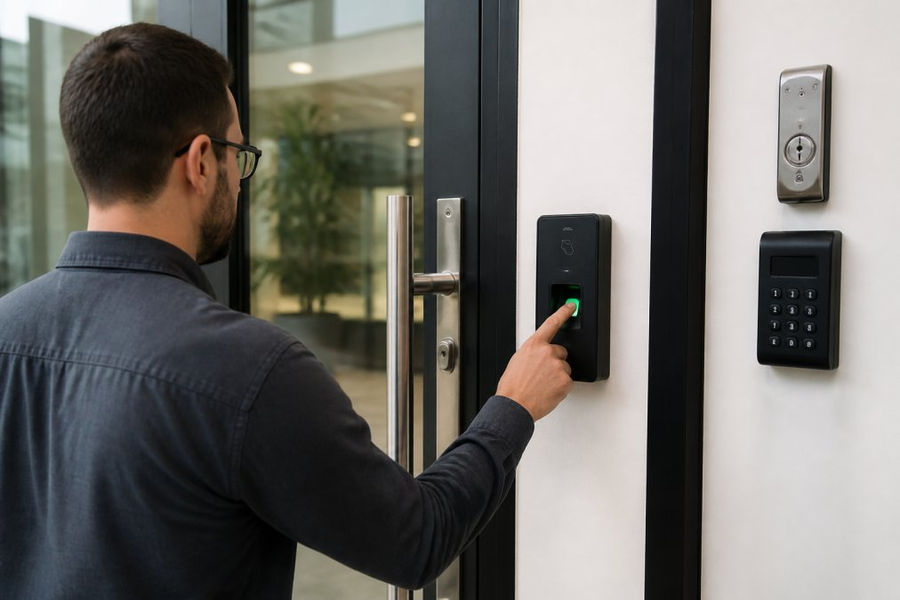
Biometric authentication (fingerprint, facial recognition, iris scanning) adds another security layer. Biometric systems authenticate based on unique physical characteristics that cannot be duplicated or shared. Facilities using biometric authentication typically maintain backup card readers or mechanical locks as fallback options.
Master Key Systems and Credential Management
Master key systems allow facility managers to control access across multiple locks with a hierarchy of keys. A master key opens all locks in the system. Individual keys open only their designated locks.
Modern electronic master key systems use software and electronic credentials to achieve the same hierarchy without mechanical complexity. The advantage is operational flexibility: a facility manager can change access permissions without physically rekeying locks, a contractor's access can be revoked by deleting their credential from the system, and temporary access for visitors can be granted for specific times and locations.
Cybersecurity Considerations for Smart Locks
Electronic locks and access control systems are connected devices. This connectivity creates cybersecurity risks that mechanical locks do not have. A compromised access control system could allow unauthorized entry, prevent authorized entry, or expose audit logs.
Protecting smart locks requires strong encryption for all wireless communications, role-based access controls in management software, regular firmware and software updates with security patches, and monitoring of access logs for suspicious patterns. When selecting smart lock systems, ask vendors about their security testing and incident response procedures.
Watch Out Smart locks are only as secure as their network infrastructure. A lock that communicates over an unencrypted wireless connection or connects to a poorly secured management system creates a security liability regardless of the lock's mechanical strength.
Key Factors to Consider When Selecting Commercial Locks
Beyond grades and hardware types, several practical factors determine whether a lock system will perform well in your specific facility.
Traffic Volume and Durability
High-traffic doors experience more wear than low-traffic doors. A lock rated for 500,000 cycles (Grade 2) will fail sooner on a door that experiences 5,000 daily openings than on a door with 50 daily openings. Estimate your facility's traffic volume by counting daily openings for critical doors. For typical office or retail environments, Grade 2 handles standard traffic well. For high-traffic public entrances or major medical facilities, Grade 1 is the appropriate choice.
Material and Weather Resistance
Locks exposed to weather, exterior doors, loading dock doors, or doors in humid environments face corrosion and material degradation. Standard commercial locks use brass or steel components. Brass resists corrosion better than steel but is softer and more expensive. Stainless steel components offer corrosion resistance and durability at higher cost. If your facility includes exterior doors or doors in corrosive environments, specify stainless steel or brass hardware.
ADA Compliance and Accessibility
The Americans with Disabilities Act (ADA) requires that commercial facilities provide accessible entry for people with disabilities. Door handles must be operable with a closed fist. Doors must open with no more than 5 pounds of force (ada.gov). Electronic locks must have manual backup mechanisms for people unable to use electronic credentials. Lever handles are ADA-compliant; knobs are not.
Total Cost of Ownership
The purchase price of a lock is only one component of total cost. Maintenance, replacement, integration with access control systems, and downtime from failures also matter. A cheap lock that fails after three years costs more than a quality lock with a ten-year lifespan. When evaluating locks, calculate total cost over the expected lifespan.
Common Mistakes to Avoid
Undersizing security for the facility type. A retail storefront or office building with Grade 3 locks invites theft and creates liability. Use Grade 2 as your baseline for any commercial facility with valuable assets or access restrictions.
Ignoring fire-code requirements. Fire-rated doors installed with standard locks create code violations and liability. Ensure all hardware carries fire-rating certification and meets building code requirements.
Mixing lock types without integration planning. A facility with both mechanical master key systems and electronic access control systems creates confusion and security gaps. Decide on a unified approach and implement it consistently.
Neglecting strike plate quality. A strong lock paired with a weak strike plate is a security failure. Upgrade strike plates to match lock grades and use screws that penetrate deep into the door frame.
Failing to account for traffic volume. Selecting a lock grade based on cost rather than traffic volume leads to premature failure and replacement. Estimate traffic honestly and choose hardware rated for that volume.
Treating cybersecurity as optional for smart locks. Electronic locks connected to networks require the same security discipline as any networked system. Weak passwords, unencrypted communications, and unpatched firmware create vulnerabilities.
Choosing commercial locks requires balancing security requirements, compliance obligations, traffic volume, and integration needs. The right system for your facility depends on what you're protecting, who needs access, and how your facility operates.
At Bay Safe and Lock, we help facility managers and business owners navigate these decisions with expertise grounded in over a decade of hands-on experience. Whether you're installing new hardware, retrofitting existing doors, or integrating access control systems, our team understands the technical requirements and can recommend solutions that match your specific facility's needs. We're licensed, fully insured, and federal level 2 background checked, ensuring that the security professionals managing your facility's access are trustworthy and qualified.
NEED AN ESTIMATE FOR YOUR PROJECT? CLICK HERE to connect with our team and discuss your commercial lock requirements.
Frequently Asked Questions
What are the differences between Grade 1 and Grade 2 commercial locks?
Grade 1 locks are the highest security rating under ANSI/BHMA standards and withstand extensive force and tampering. Grade 2 locks are slightly lower in security but still suitable for most commercial applications. Grade 1 is required for high-security facilities like banks and government buildings, while Grade 2 works well for retail stores, offices, and restaurants. The choice depends on your facility's security needs and traffic patterns.
Are commercial door locks different from residential locks?
Yes. Commercial locks are built for higher traffic, heavier use, and stricter security standards. They use ANSI/BHMA grading (residential locks do not), feature reinforced strike plates, and support master key systems for multi-unit facilities. Commercial locks also integrate with access control systems and must meet fire codes. Residential locks prioritize convenience and aesthetics over the durability and integration capabilities commercial locks provide.
How do I determine the fire rating requirements for my commercial doors?
Fire ratings depend on your building's occupancy type and local fire codes enforced by your jurisdiction. Life safety codes require specific fire-rated hardware on doors in stairwells, emergency exits, and between high-risk areas. Consult your local fire marshal or building department to identify which doors need fire-rated hardware. Door closers, exit devices, and locksets must all carry fire ratings matching your door's rating (typically 20, 45, 60, or 90 minutes).
What is the best commercial lock for high-traffic areas?
Grade 1 mortise locks are ideal for high-traffic areas due to their durability and tamper resistance. Pair them with heavy-duty strike plates and door closers to handle constant opening and closing. Keyless entry systems or access control integration work well in high-traffic facilities like hospitals and retail stores, reducing wear on mechanical components and improving security tracking. Material quality and regular maintenance extend lock life in demanding environments.
How does master key system integration work with commercial locks?
A master key system uses a hierarchy of keys: individual keys open single doors, sub-master keys open groups of doors, and the master key opens all doors. This system requires specialized mortise or cylindrical locks with matched pins. Master key systems are essential for property managers overseeing apartment complexes or multi-tenant buildings, allowing efficient access control without duplicating keys for every lock. Professional installation ensures the system functions securely.
What cybersecurity risks do smart commercial locks face?
Smart locks transmit credential data electronically, making them vulnerable to hacking if not properly secured. Choose systems with encryption, regular firmware updates, and audit trails that track access attempts. Avoid locks with outdated wireless protocols or weak password requirements. Pair smart locks with a comprehensive access control system that monitors for unusual activity. Hybrid systems combining mechanical and electronic security provide redundancy if one system fails.
NEED AN ESTIMATE FOR YOUR PROJECT? CLICK HERE
This article was written using GrandRanker


Comments