

Preventing Unauthorized Access to Commercial Safes
Quick Summary
Preventing unauthorized access to commercial safes means ranking what the safe holds, placing it out of sight and bolted down, limiting access to the fewest people through unique credentials, tracking every key, and keeping a log. Changing the combination whenever someone with knowledge of it leaves keeps access controlled.
Rank safe contents by how much harm a loss would cause before setting controls.
Bolt the safe to the floor or wall slab and keep it out of customer view.
Give each person a unique credential and never share codes between staff.
Keep a written key register and collect keys from departing employees the same day.
Change the combination when someone leaves and review the access log weekly.
Table of Contents
Start With a Prioritized Inventory of What the Safe Holds
Preventing unauthorized access to commercial safes starts before anyone touches a lock. Listing what the safe holds, ranked by how much harm a loss would cause, is a sound starting point. Cash, signed contracts, payroll records and original deeds sit at the top. Spare supplies and old files usually sit near the bottom.
A prioritized list tells you how strict the controls need to be. A safe holding a week of cash needs tighter access than one holding back-up forms. Write each item down, note who needs it, and mark whether it can be replaced.
Cash and checks on hand
Legal documents and original contracts
Payroll and personnel records
Backup drives and sensitive client data
Spare keys, codes and access cards
Keep the list short and update it whenever the business changes. New accounts, new staff and new record types all change the risk picture.
Choosing a Practical Layout and Location for the Safe
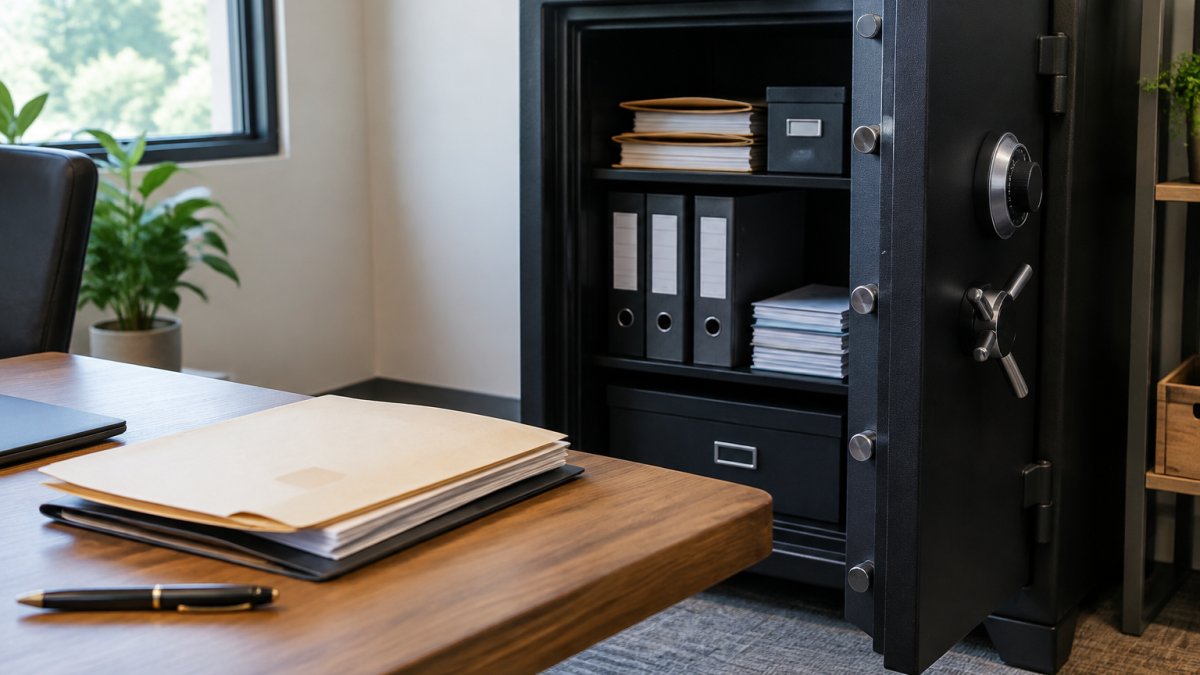
Where the safe sits matters as much as the lock on it. Place the safe in a room that is not visible from the front door or the customer area, and bolt it to the floor or a wall slab so it cannot be pried loose or carried away. Keep it near the people who use it most, but out of the path of foot traffic, a back office with a lockable door usually works better than a hallway closet. Confirm the floor can support the loaded weight, and make sure the open door will not block an exit or a walkway.
Interior arrangement also affects security, because a disorganized safe forces people to prop the door open, dig through stacks, and leave records exposed. Treat the interior like a filing system with zones:
Tier 1, daily access: cash drawers, deposit bags, and the current-day log. Keep these at the front of the top shelf so routine openings are short.
Tier 2, weekly access: payroll files, signed contracts awaiting countersignature, and check stock. Middle shelves or a hanging-folder rack.
Tier 3, rare access: original deeds, entity formation documents, insurance policies, and backup credentials. Sealed envelopes or a locked inner compartment at the back or bottom.
Use labeled binders, expandable folders, or archival document sleeves rather than loose stacks, and give every container a short code (for example, "T1-CASH," "T3-DEEDS") that matches an index kept outside the safe. The index is the map: it lists each container, what it holds, who is authorized to retrieve it, and the date it was last reviewed. Without the index, a well-organized safe is still a black box to anyone other than the person who packed it.
Fire-rated and water-rated safes have limits printed on their data label, so check that rating before relying on it. Keep paper records in the inner compartment or in document sleeves, and do not store backup drives in the same compartment as paper if the safe is rated only for paper; media generally tolerates lower heat than paper does.
Humidity can be a concern. A safe in a basement, against an exterior wall, or near water pipes may be exposed to condensation, so consider a less damp location where you can. Also respect capacity: overfilling a safe can jam the door, bend the bolt work, and force users to leave it ajar between openings, which defeats the lock entirely.
Commercial Safe Access Control: Limiting Who Can Open It
Access control answers one question: who can open the safe, and when? Most businesses give access to too many people, often without a written record. Limit access to the fewest people who truly need it, and make the limit enforceable rather than aspirational. You can see the safe lock services Bay Safe & Lock furnishes, installs, and programs to set up restricted access.

Set up access in layers, and tie each layer to a mechanism:
Primary: Owner or manager only, with a unique credential that is never shared.
Secondary: Shift lead or accountant for specific tasks, scoped to the times and days those tasks happen.
Emergency: A sealed envelope or sealed credential held by a trusted outside party, opened only under a documented procedure.
Electronic locks can create an audit trail, which is useful for a business. Many models allow individual user codes or key cards and can record opening history. Use those features instead of a single shared code.
Mechanical dial locks give no record of who opened them, so if you keep one, pair it with a written log and change the combination on a fixed schedule. With any lock, change or deactivate credentials the same day someone leaves the business, is reassigned, or is suspected of misuse, not at the next quarterly review.
Build a written access list that names each person, their credential type, the tier they belong to, and the date access was granted. Review it every quarter and after every staff change. Reconcile the list against the lock's audit trail: anyone who appears in the opening history but not on the list is a finding, and any credential that has not been used in ninety days is a candidate for removal.
Watch out: shared codes and borrowed key cards erase accountability. If two people know the same code, the audit trail can no longer tell you who opened the safe, and the log becomes a record of openings rather than a record of people. When a shared code is unavoidable, change it immediately after any departure and note the change in the access list.
Finally, separate the safe from the records that describe it. Keep the access list, the key register, and the combination history in a locked cabinet or an access-controlled digital file outside the safe, so a person who gains entry to the safe does not also gain the map to everything in it.
Business Safe Key Management: Tracking Every Physical Key
Keys are often the weakest point. Duplicated keys, keys left in drawers and keys taken home by former staff all create openings. A written key register that lists each key, its holder and the date it was issued is a useful practice.
When an employee leaves, collect their keys the same day. Our guide on rekeying commercial locks after employee turnover explains the steps to take.
Common mistake: assuming a lost key is harmless because "nobody would use it." Treat every unaccounted key as a reason to rekey the lock.
When and How to Change a Commercial Safe Combination
Change the combination whenever someone with knowledge of it leaves, is reassigned or is suspected of misuse. For background on how commercial safe locks are maintained and serviced, see this guide. Also change it on a regular schedule, such as every six to twelve months, even when nothing has changed.
Follow these steps:
Confirm the safe is closed and empty of any items needed right away.
Record the old combination's removal date in the access log.
Use the manufacturer's procedure to set the new combination.
Test the new combination at least three times before closing the door.
Give the new code only to authorized users, in writing, and keep one sealed copy in the register.
If the safe is an electronic model, check the battery and the lockout settings during the same visit.
Building a Safe Access Log Template That Works
A safe access log turns an unknown into a record. Each entry should show the date, time, person, reason for opening and the time the safe closed. Keep the log in the same area as the safe, but not inside it.
Use simple columns:
Date | Time Opened | Person | Reason | Time Closed | Initials |
Review the log weekly. Look for openings at odd hours, repeated short visits or missing entries. A good log makes gaps easy to spot and gives you proof when questions come up.
Planning Emergency Access and Lost-Combination Procedures
Every commercial safe needs an emergency plan. If the only person with the code is injured, absent or has left, the business should still be able to get in safely. Store a sealed copy of the code with a trusted outside party, such as a bank or attorney, and record who holds it.
If a combination is lost, do not guess or force the lock. If you have lost safe keys instead, review your recovery options before choosing a next step. Bay Safe & Lock offers non-destructive entry and safe repair services for this situation. Contact a qualified safe technician to assess the options. Make sure the business keeps paperwork that shows ownership, since technicians may ask for it.
Plan ahead for these cases:
Document who can authorize an emergency opening
Keep the sealed backup code in a second location
Know the name of a service provider before you need one
Scheduling Your Next Safe Security Review With Bay Safe and Lock
Security is not a one-time setup. Schedule a review at least once a year, or sooner after any staff change. During the review, check the access list, key register, log and combination history against what actually happens day to day.
Bay Safe and Lock can help with safe and lock service and repair. To get an estimate for your project, click here.
Frequently Asked Questions
What documents should be stored in a safe?
Store documents that are hard or expensive to replace and that would cause harm if lost or copied: original contracts, property deeds, backup drives with encrypted data, cash-handling records, and spare keys to other secured areas. Avoid storing items that need frequent access, since every opening adds exposure. Keep current copies of key business records off site as well, because a fire-rated safe protects paper up to its rating but not against flooding or theft of the whole unit. Review the contents every quarter so outdated documents do not accumulate.
How often should a commercial safe's access codes be changed?
Change the combination whenever someone with knowledge of it leaves the business, whenever a key or code may have been compromised, and at least once a year as routine maintenance. Changing codes after a staff departure is the most important trigger, because former employees often retain the code longer than anyone expects. Log each change in your access record, noting the date, the reason, and who performed it, so the history stays auditable.
What should a business do if a safe key or access code is lost?
Treat a lost key or code as a potential breach until you confirm otherwise. Immediately restrict the affected user's access, record the loss in your access log, and arrange a combination change or lock rekey as soon as possible. Review recent safe activity to see whether the safe was opened after the loss was discovered. If the safe cannot be opened, a qualified locksmith may be able to help.
How can a business track who has accessed a commercial safe?
Use a written access log for manual safes and an electronic audit trail for safes with keypad or biometric locks. Each entry should record the date, time, person, reason for access, and whether the safe was closed afterward. Electronic systems can time-stamp every opening automatically, which reduces the chance of gaps. Review the log weekly, and investigate any opening that lacks a matching business reason.
Comments