top of page

Table of Contents

  • Plant City Locksmith Alternatives at a Glance

  • How to Find a Reliable 24-Hour Locksmith

    • Verify Licensing and Insurance

    • Check Response Times and Service Areas

  • Locksmith Licensing Requirements and Credentials

  • Emergency Lockout Services Cost and Pricing Factors

  • Comparing Service Options by Property Type

    • Residential Locksmith Services

    • Commercial and Industrial Security

  • Key Services to Expect from Your Locksmith

  • Red Flags and How to Avoid Locksmith Scams

  • Conclusion

Last Updated: August 29, 2026

Plant City Locksmith Alternatives at a Glance

Finding the right locksmith alternatives requires understanding what separates a trustworthy professional from someone who'll overcharge and disappear. The market includes established family-owned shops, 24/7 mobile response teams, security system integrators, and more, each operating differently and charging differently.

Bay Safe and Lock has spent over a decade working directly with homeowners, property managers, and business owners in Plant City. The core issue isn't finding someone who can pick a lock. It's finding someone who understands your specific situation, whether you're locked out at midnight, managing access across multiple units, or securing a medical facility where unauthorized access is a liability.

This guide covers the major locksmith alternatives available in Plant City, what to expect from each service type, and how to avoid common traps that leave people frustrated and overcharged.

How to Find a Reliable 24-Hour Locksmith

A reliable locksmith shows up when promised, charges what they quoted, and leaves your locks and doors in better condition than they found them.

Verify Licensing and Insurance

Start here. This is non-negotiable. A licensed locksmith must carry a business license and pass a background check. In Florida, locksmiths must be registered with the Department of Business and Professional Regulation (DBPR). This means the person working on your property has been vetted and has a legal obligation to follow industry standards.

Insurance matters equally. A bonded and insured locksmith carries liability coverage that protects you if something goes wrong. If an uninsured locksmith damages your door frame, you're paying for repairs out of pocket. An insured locksmith's coverage handles it.

Professional locksmith in uniform displaying credentials and identification badge while standing confidently in front of a service vehicle with company branding

Ask directly: "Are you licensed with the DBPR?" and "Can you provide proof of insurance?" Legitimate services answer immediately and offer documentation. If they hesitate or claim licensing "doesn't matter," move on. Bay Safe and Lock maintains Federal level 2 background clearance and full insurance coverage because verification matters to clients letting someone into their home or business.

Check Response Times and Service Areas

A 24-hour locksmith is only useful if they reach you in reasonable time. Some claim 24/7 availability but operate from a single location 30 minutes away. Others dispatch mobile teams reaching most of Plant City within 15-30 minutes.

Before calling, check their service map. Do they explicitly cover your neighborhood? If you're in an outlying area, confirm they'll dispatch to you before you need them in an emergency.

Response time promises should be specific: "We aim for 30 minutes or less" or "Average arrival is 45 minutes." If a service says "as soon as possible," that's not a commitment. Real response times are measurable.

Locksmith Licensing Requirements and Credentials

Florida doesn't have a single statewide locksmith license, but locksmiths operating as service providers must register with the DBPR and comply with local regulations. Registration requires a background check and proof of business legitimacy.

Beyond state registration, look for additional credentials. Some locksmiths pursue certification through the Associated Locksmiths of America (ALOA), which requires demonstrated competency and adherence to a professional code of ethics (aloa.org). Certified locksmiths have invested in proving they know their trade.

Federal background clearance, like Bay Safe and Lock's level 2 clearance, goes beyond what most locksmiths offer. This level of vetting is typically required for sensitive environments like medical facilities or government buildings, signaling the technician has passed thorough screening.

Insurance and bonding are credentials too. A bonded locksmith has posted a financial guarantee they'll operate legally and ethically. Bonding costs money, so they only carry it if serious about the business.

When evaluating alternatives, ask about DBPR registration, professional certifications, background clearance level, insurance coverage limits, and bonding. The answers tell you whether you're dealing with a professional operation.

Emergency Lockout Services Cost and Pricing Factors

Pricing for locksmith services varies based on several factors. Understanding what drives those differences helps you avoid sticker shock and scams.

Service time matters. A simple residential lockout during business hours costs less than the same lockout at 2 a.m. on Sunday. After-hours service, emergency response, and weekend/holiday rates are legitimate cost multipliers.

Property type affects pricing. Opening a residential deadbolt is simpler than rekeying a commercial master key system or opening a high-security safe. Complexity drives labor time, which drives cost.

Lock type matters too. Opening a standard pin-tumbler residential lock takes 10-15 minutes for a professional (peer-reviewed research). Opening a high-security transponder key system requires different tools and expertise, costing more.

Materials and hardware add cost. A basic deadbolt costs less than commercial-grade locks with master key capability. Rekeying is cheaper than replacing, but replacement with better hardware is sometimes the smarter investment.

Transparent pricing is a hallmark of legitimate services. Before work begins, a professional locksmith should provide a quote or explain how they charge. Avoid locksmiths who won't quote before showing up or who dramatically increase the price once they've assessed the job.

Comparing Service Options by Property Type

Different properties have different security needs.

Residential Locksmith Services

For homeowners, core services are emergency lockout assistance, lock rekeying, deadbolt installation, and smart lock integration.

Emergency lockout is straightforward: you're locked out, they pick or bypass the lock and get you back inside without damaging the door. Response time matters, being locked out is stressful.

Rekeying is valuable if you've moved into a home where previous owners might have keys, or if you've lost a key. A locksmith removes the lock cylinder, replaces internal pins, and resets it so old keys no longer work. It's faster and cheaper than replacing the entire lock.

Deadbolt installation ensures a quality bolt extends fully, the strike plate is properly secured, and the door frame can handle the load.

Smart lock installation is increasingly common. A locksmith can install and integrate smart locks with your existing hardware, requiring both locksmithing skill and familiarity with the specific system.

Commercial and Industrial Security

Commercial properties need more complex solutions. A retail store needs different security than a medical facility or industrial warehouse.

Master key systems allow a property manager to access all locks with one key, while individual tenants have keys opening only their specific locks. Designing a master key system requires expertise, the wrong design creates security gaps.

Access control systems use key cards, PIN codes, or biometric authentication instead of physical keys (nist.gov). These systems log who accessed what and when, creating an audit trail. For restricted areas like medical records rooms, access control is often required for compliance.

High-security locks resist picking, bumping, and other bypass techniques. They're more expensive but necessary in high-risk environments. A commercial locksmith should recommend appropriate hardware based on your facility's risk profile.

Safe services are essential if you store cash, documents, or valuables. A locksmith can install safes, repair damaged ones, open safes when combinations are lost, and recommend appropriate types.

Key Services to Expect from Your Locksmith

Key duplication is the simplest service. A locksmith can copy most standard keys in minutes. Restricted key blanks add security but require specific authorization.

Key extraction handles broken keys inside locks. A locksmith has extraction tools that remove the broken piece without damaging the mechanism.

Transponder key programming is increasingly common for vehicles. Modern car keys contain a chip communicating with the vehicle's immobilizer. A locksmith can program a new transponder key to work with your vehicle.

Smart key and fob services include replacing lost key fobs, programming new ones, and troubleshooting keyless entry problems.

Lock rekeying and repair handle worn, damaged, or malfunctioning locks. A lock that's hard to turn or doesn't fully engage needs attention.

Lock installation covers deadbolts, mortise locks, electronic locks, and specialty hardware. Professional installation ensures proper function and security.

Safe opening and repair is specialized work. A locksmith can often open inherited safes, restore lost combinations, or repair damaged safes without destroying them.

Red Flags and How to Avoid Locksmith Scams

The locksmith industry attracts scammers because desperate people are willing to pay premium prices quickly.

Bait-and-switch pricing is most common. A service quotes low over the phone, arrives, assesses the job, and suddenly the price triples due to "complications." Legitimate services provide accurate quotes upfront. Confirm the final price in writing before work begins.

Close-up of a homeowner carefully reviewing contract details and pricing paperwork at a desk, with a phone and notepad visible, demonstrating thorough decision-making

Unlicensed operators have no insurance, don't follow industry standards, and have no accountability if something goes wrong. Always verify licensing before hiring. A quick call to the DBPR confirms registration.

Damage during service is a red flag. A skilled locksmith opens locks with minimal or no damage. If damage occurs, ask whether it was necessary or preventable.

Pressure to replace locks when rekeying would work is a common upsell. Rekeying is cheaper for the customer but generates less revenue for the locksmith. Get a second opinion if replacement is recommended without clear explanation.

Refusing to provide a written estimate or contract is a warning sign. Professional services document what they're doing, what it costs, and what's included. Cash-only payment with no receipt is a scam signal.

Vague credentials are another indicator. If a locksmith can't clearly explain their licensing, insurance, or background clearance, they're probably not legitimate.

Call ahead and verify. Before a locksmith arrives, confirm they're from the company you called. Verify the technician's ID and vehicle match the company information.

Finding the right locksmith alternative depends on matching your specific needs, emergency lockout, security upgrades, master key systems, or specialized safe work, with a service that has the expertise and credentials to deliver. Bay Safe and Lock specializes in this range of services for Plant City properties. With over a decade of hands-on experience, Federal level 2 background clearance, and full insurance coverage, we handle everything from residential emergency lockouts to complex commercial access control and safe fabrication. When you need an estimate for your project, we're ready to discuss your security needs and provide transparent pricing. NEED AN ESTIMATE FOR YOUR PROJECT? CLICK HERE

Frequently Asked Questions

How can I verify if a locksmith is licensed and insured?

Ask the locksmith for their license number and insurance certificate before they begin work. Contact your state's licensing board to confirm their credentials are current and valid. Reputable locksmiths will provide this information without hesitation. Federal background checks (at least level 2) and bonding add extra assurance. Always request references from previous customers in your area.

What factors affect emergency lockout services cost?

Pricing depends on the time of service (after-hours fees apply), type of lock, property type (residential vs. commercial), and complexity of the job. Damage assessment and lock replacement costs vary. Contact your locksmith directly for a quote based on your specific situation. Transparent, upfront pricing without hidden fees is a sign of a trustworthy provider.

What locksmith licensing requirements apply in this state?

Locksmiths must comply with state regulations that typically require a business license, proof of insurance, and background screening. Many operate under local business licensing requirements. Some states mandate specific training or apprenticeship hours. Always confirm your locksmith holds a valid business license and meets bonding requirements. Ask about their credentials before hiring.

How quickly can a 24-hour locksmith respond to emergencies?

Response times typically range from 30 minutes to an hour, depending on traffic and service area. Mobile locksmiths with on-site inventory often arrive faster. When calling for emergency service, ask for an estimated arrival time upfront. Locksmiths available 24/7 should have multiple teams to handle peak-demand periods. Proximity to your location directly affects response speed.

NEED AN ESTIMATE FOR YOUR PROJECT? CLICK HERE

This article was written using GrandRanker


Table of Contents

  • Why Rekeying Your Apartment Complex Matters

  • Rekeying vs. Replacing Locks: Which Makes Sense

  • Understanding Master Key System Installation

  • The DIY Rekeying Process: Tools and Steps

    • Tools Required for Rekeying

    • Step-by-Step Rekeying Instructions

  • Cost to Rekey Apartment Building: Budget Planning

  • Restricted Keyway Systems: Preventing Unauthorized Duplication

  • When to Call a Professional Locksmith

  • Key Management and Security Protocols

Last Updated: August 28, 2026

Why Rekeying Your Apartment Complex Matters

Tenant turnover is constant in apartment management. When residents move out, departing tenants keep their keys, and anyone they gave duplicates to could access the building. This creates a genuine security vulnerability that compounds with every vacancy.

Rekeying solves this directly. Instead of replacing entire lock hardware, rekeying changes the internal pin configuration so old keys no longer work. New tenants get new keys that fit the same physical locks. Understanding when and how to rekey your apartment complex can save thousands in replacement costs while maintaining the security standards your residents expect.

Rekeying vs. Replacing Locks: Which Makes Sense

The choice between rekeying and replacing locks depends on the condition of your existing hardware and your budget.

Rekeying involves removing the lock cylinder, extracting old key pins, and installing new pins that match a fresh key blank. The exterior hardware stays intact. This approach costs significantly less than replacement and takes less time. For apartment complexes with functioning locks in decent condition, rekeying is the practical choice.

Replacing locks means removing the entire lock assembly and installing new hardware. This makes sense when locks are damaged, corroded, or unreliable. New locks also give you the opportunity to upgrade to higher-security options like restricted keyway systems that prevent unauthorized duplication.

For most apartment complexes managing routine tenant turnover, rekeying is the more cost-effective solution.

Understanding Master Key System Installation

A master key system is a hierarchical access structure where a single "master key" opens multiple locks, while individual tenant keys open only their assigned units. This simplifies property management by allowing maintenance staff, managers, and emergency responders to access units without carrying dozens of individual keys.

Master key systems work by using a specific pin configuration that allows both the individual key and the master key to operate the same lock. Installing a master key system requires planning before rekeying begins. You must decide which locks the master key will access, typically common areas like laundry rooms and storage facilities, while individual units use tenant-specific keys.

The installation process involves selecting compatible lock cylinders and having a locksmith rekey them to match your master key specifications. This is not a DIY project. Master key systems require specialized knowledge of pin heights, key blank compatibility, and security protocols. Professional locksmiths have the expertise and equipment to ensure each lock is keyed correctly to your specifications.

The DIY Rekeying Process: Tools and Steps

Rekeying a single lock is technically possible as a DIY project if you have the right tools and patience. However, for an apartment complex with multiple units, the time investment and risk of error make professional service more practical.

Tools Required for Rekeying

A rekeying kit typically includes a plug follower (prevents pins from falling out when you remove the cylinder), a pinning mat (keeps pins organized), tweezers for handling individual pins, and a small screwdriver. You'll also need the rekeying kit specific to your lock brand, Schlage and Kwikset are the most common, and the new key blank that matches your desired key.

Step-by-Step Rekeying Instructions

Step 1: Remove the lock cylinder from the door. Locate the set screw on the interior side and slide the cylinder out from the exterior side.

Step 2: Insert the plug follower. This prevents springs and pins from falling out when you work on the cylinder.

Step 3: Remove the cylinder retaining ring. This holds the pins in place. Springs underneath are under tension.

Step 4: Dump out the old pins. Keep them in your pinning mat to avoid losing them.

Step 5: Install new pins according to your new key. Each pin height corresponds to a specific cut on your new key blank. Place each pin in order from the back of the cylinder forward.

Step 6: Replace the retaining ring and springs. The springs should sit on top of each pin.

Step 7: Test the new key. It should turn smoothly without binding.

Step 8: Remove the plug follower and reinstall the cylinder. Slide the cylinder back into the door and secure it with the set screw.

This process takes 10-15 minutes per lock if experienced. For a first-time attempt, expect 20-30 minutes per lock. For an apartment complex with 15 units, DIY work means 5-7 hours spread across multiple days.

Close-up of rekeying tools arranged on a wooden work surface: plug follower, pinning mat with organized pins by height, tweezers, small screwdriver, and lock cylinder components with springs visible

Cost to Rekey Apartment Building: Budget Planning

The cost to rekey an apartment building depends on the number of units, the complexity of your master key system, and whether you hire professionals or attempt the work yourself.

Professional rekeying services typically charge per lock (aloa.org). For an apartment complex with 15 units, professional rekeying of all units plus common area locks represents a moderate expense, significantly less than replacing hardware entirely.

If you attempt rekeying yourself, your primary costs are rekeying kits ($15-40 each) and new key blanks ($2-5 each). For 15 units plus common areas, material costs might range from $100 to $300.

However, the hidden cost of DIY rekeying is your time. If you value your time at any reasonable hourly rate, labor costs often exceed material savings. Additionally, mistakes requiring professional correction mean paying for professional service plus the cost of your failed attempt.

For apartment complexes, if you have only a few units to rekey, DIY is feasible. If you're managing 10 or more units, especially with a coordinated master key system, professional service becomes the practical choice. Bay Safe and Lock can handle bulk rekeying projects efficiently, reducing per-unit costs.

Restricted Keyway Systems: Preventing Unauthorized Duplication

A restricted keyway is a lock design where the key blank has a unique shape that prevents duplication at standard hardware stores. Only authorized locksmiths with access to the restricted key blank can create copies.

Standard keyways like Schlage and Kwikset use universal key blanks available at any hardware store. Restricted keyways eliminate this vulnerability. The key blank is proprietary and only available through authorized distributors or your locksmith.

Implementing a restricted keyway system requires replacing your existing lock cylinders with restricted versions. This is a capital investment, but it provides ongoing security benefits. You maintain control over key duplication. If a tenant needs an extra key, they contact you, you contact the authorized locksmith, and the locksmith creates the duplicate. This creates an audit trail and prevents unauthorized copies.

For apartment complexes concerned about security, especially high-turnover properties or those in areas with higher crime rates, the added expense is justified by the control and security it provides.

When to Call a Professional Locksmith

Call a professional locksmith if you're installing a master key system. The coordination required to ensure individual tenant keys work only for their units while a master key provides access to common areas requires expertise and specialized equipment. Bay Safe and Lock has the experience to design and install master key systems that work reliably across your entire complex.

Call a professional if your existing locks are damaged, corroded, or stuck. Attempting DIY rekeying will only make the situation worse.

Call a professional if you need restricted keyway systems installed. The selection of the right keyway system and installation of compatible lock cylinders requires knowledge beyond basic rekeying.

Call a professional if you need to rekey your entire apartment complex quickly. A single locksmith can rekey multiple units in a day, whereas DIY work spreads across many days.

Licensed locksmith technician in work vest using specialized tools to rekey a residential deadbolt on a metal door frame, with professional tool bag visible in background

Key Management and Security Protocols

A key management system is the operational framework that controls who has keys, what those keys access, and how keys are tracked.

Start with a clear policy about who receives keys. Typically, tenants receive two keys per unit. Maintenance staff receive a master key or sub-master key with limited access. Property managers receive a master key. Document who has which keys and update this documentation every time a tenant moves out or staff changes.

Implement key control by using restricted keyway systems. When key duplication requires authorization, you prevent tenants from making unauthorized copies.

Establish a key return process when tenants move out. Require tenants to return all keys before receiving their security deposit. If a key is not returned, document this and consider the cost of rekeying that unit as a deduction from the deposit.

Track key changes and rekeying events. Document when units are rekeyed, which keys were issued, and to whom. This creates an audit trail that helps you understand your security posture.

Element

Purpose

Implementation

Key inventory

Track all keys in circulation

Document tenant keys, staff keys, and backup keys

Return process

Recover keys from departing tenants

Require key return before deposit release

Restricted keyway

Prevent unauthorized duplication

Use proprietary key blanks available only through authorized locksmiths

Master key system

Enable staff access to multiple units

Install hierarchical locks allowing both individual and master key access

Rekeying schedule

Maintain security after turnover

Rekey all units when tenants depart

Audit trail

Understand access patterns

Document all key changes and who has access to what

Rekeying your apartment complex is a fundamental part of property security and tenant turnover management. Whether you handle it yourself for a few units or engage a professional locksmith for comprehensive master key system installation, the goal remains the same: ensuring that only authorized individuals have access to each unit and common area. Bay Safe and Lock brings over a decade of hands-on experience managing security for residential properties. Our licensed and insured team can design a key management system tailored to your complex's needs, install restricted keyway systems to prevent unauthorized duplication, and handle bulk rekeying projects efficiently. NEED AN ESTIMATE FOR YOUR PROJECT? CLICK HERE to discuss your apartment complex's security requirements with our team.

Frequently Asked Questions

Q: Can I rekey apartment complex locks myself?

A: You can rekey individual locks yourself if you have basic mechanical skill and the right tools, but rekeying an entire apartment complex is not practical for DIY. Bulk rekeying requires consistency across dozens of units, specialized equipment, and knowledge of master key system compatibility. Most property managers hire a certified technician to ensure security, consistency, and proper key control across all units. A professional locksmith can complete the job faster and guarantee that every lock functions correctly with your new key system.

Q: Is it cheaper to replace locks or rekey apartment building locks?

A: Rekeying is almost always cheaper than replacing locks. Rekeying reuses your existing lock hardware and only changes the internal key pins and tumbler configuration. Replacement means buying new locks entirely. For an apartment complex with multiple units, the cost difference becomes significant. The exact savings depend on the number of units, lock quality, and whether you're installing a master key system. Contact a locksmith for a quote comparing both options for your specific situation.

Q: What is the difference between rekeying and changing locks?

A: Rekeying changes the internal mechanism of an existing lock so it works with a new key, but the lock hardware stays in place. Changing locks (replacement) removes the old lock entirely and installs a new one. Rekeying preserves your current deadbolts, exterior doors, and hardware compatibility. It's faster, less disruptive, and more cost-effective for apartment complexes. However, if your locks are damaged, outdated, or you need to upgrade to a different brand like Schlage or Kwikset, replacement may be necessary.

Q: How do master key systems work for apartment complexes?

A: A master key system uses a hierarchy of keys that allows different access levels. Residents get keys that open only their individual units, while property management holds a master key that opens all units. The system works by aligning key pins and tumblers at multiple shear lines within each lock cylinder. This setup is ideal for tenant turnover, maintenance access, and emergency situations. Professional installation ensures security and prevents unauthorized key duplication. Proper key control policies are essential to prevent master keys from being lost or copied.

NEED AN ESTIMATE FOR YOUR PROJECT? CLICK HERE

This article was written using GrandRanker


Table of Contents

  • How to Diagnose Electronic Keypad Safe Problems

    • Check the LED indicator and beeping sequence

    • Identify common error codes

  • Safe Keypad Battery Replacement

    • Locating and removing the battery

    • Voltage drop testing and continuity checks

  • Cleaning and Maintaining Lock Components

    • Removing debris from the keypad cable and terminals

    • Inspecting the lock body and solenoid

  • Resetting Factory Settings and Lockout Mode

    • Performing a factory reset with override key

    • Recalibrating the keypad after reset

  • Troubleshooting Unresponsive Keypads

    • Testing circuitry and wiring harness connections

    • Checking for faulty signals and tamper-resistant features

  • When to Call a Professional Safe Technician

    • Hardware replacement and firmware issues

    • Security risks of DIY repair attempts

  • Common Mistakes to Avoid

  • Conclusion

Last Updated: August 27, 2026

How to Diagnose Electronic Keypad Safe Problems

When an electronic keypad safe stops responding, most issues follow a predictable pattern and many are fixable without professional help. Electronic safes give you clues through beeps, lights, and error codes that tell you exactly what's wrong if you know how to read them.

Check the LED indicator and beeping sequence

Most digital safes have an LED indicator and beeping pattern that communicate the safe's status. A steady green light typically means normal operation, while a red light or rapid beeping usually indicates a problem. Write down the exact beeping pattern, a single long beep often signals low battery voltage, while rapid beeping usually means an incorrect code entry or faulty keypad signal. If your safe produces no light or sound, the battery is likely completely dead or disconnected.

Identify common error codes

Many electronic safes display error codes on an LCD screen or communicate them through specific beep sequences. A "1-2-3" beep pattern often indicates low battery, while a continuous high-pitched tone usually means the solenoid isn't receiving proper voltage. Check your safe's manual for the specific codes your model uses, the manufacturer's website often has downloadable PDFs with complete error code lists. Immediate errors suggest a hardware or power issue, while errors after repeated tries suggest a lockout mode.

Safe Keypad Battery Replacement

A dead or dying battery is the most common reason an electronic keypad safe becomes unresponsive. Most electronic safes use a 9-volt alkaline battery, though some models use AA or AAA batteries (nfpa.org). When voltage drops below a certain threshold, the safe stops responding to keypad input.

Locating and removing the battery

The battery compartment is usually inside the safe, accessed through the door. Once you have access, look for a small plastic or metal box with two wire terminals. Before removing the battery, take a photo of the wire connections so you can reattach them correctly. Gently disconnect the wires from the battery terminals, some batteries have a snap connector that pops off easily, while others have wires soldered directly to the terminals. Once disconnected, remove the old battery and note its size and voltage rating.

Close-up of hands carefully removing a 9-volt alkaline battery from the junction box of a digital safe lock, showing the red and black terminal wires and the plastic battery holder against a workbench

Voltage drop testing and continuity checks

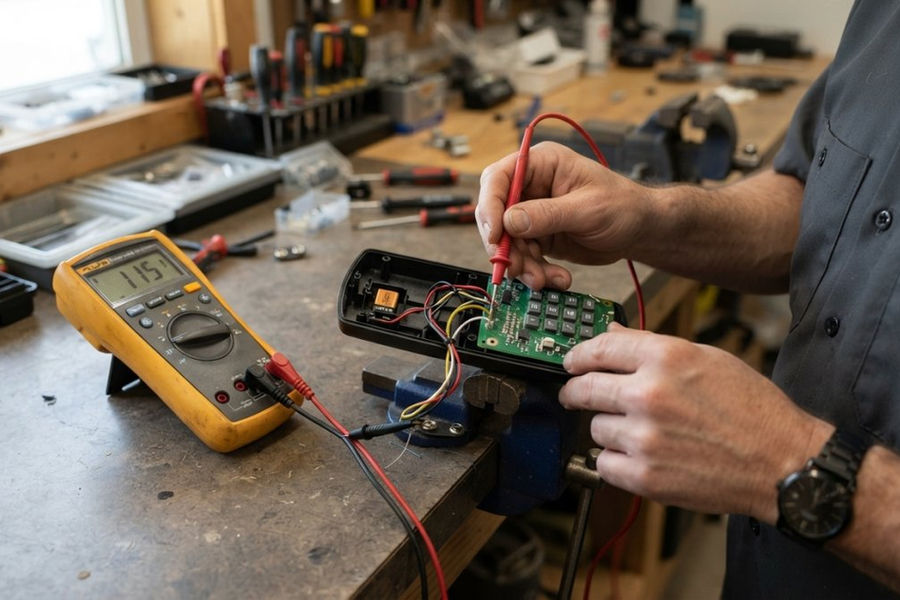
Before installing a new battery, test the old one with a multimeter to confirm it's actually dead. Set the multimeter to DC voltage mode and touch the probes to the battery terminals. A fresh 9-volt battery reads approximately 9 volts; a battery reading below 7 volts is too weak to power the solenoid reliably (peer-reviewed research). After replacing the battery, perform a continuity test on the wiring harness by setting the multimeter to continuity mode and touching one probe to each end of the red wire, if the multimeter beeps, the wire is intact. Repeat with the black wire. Also check the terminal connections for corrosion or loose contacts; if terminals look discolored, gently clean them with a dry cloth or fine sandpaper. Install the new 9-volt battery, reconnecting the wires to the correct terminals, and test the keypad.

Cleaning and Maintaining Lock Components

Dust, debris, and corrosion inside the keypad or lock body can prevent proper electrical contact and mechanical function. The keypad cable is particularly vulnerable to contamination, this flexible ribbon connector links the keypad buttons to the main circuit board, and if dirt or oxidation builds up on the connector pins, the keypad won't register your key presses.

Removing debris from the keypad cable and terminals

Start by powering down the safe and using a dry cloth or compressed air to blow out any visible dust from the keypad buttons. Avoid using liquids, water can damage the circuitry. If the keypad still doesn't respond, you may need to access the keypad cable inside the safe by removing the keypad faceplate, which usually has 2-4 screws. Once the faceplate is off, gently disconnect the flat, flexible keypad cable from the circuit board. Inspect the connector pins for corrosion, which appears as green or white deposits. If you see corrosion, use a soft pencil eraser or fine-grit sandpaper to gently clean the pins. Reconnect the keypad cable, ensuring it seats fully, and reinstall the faceplate screws.

Inspecting the lock body and solenoid

The solenoid is the electromagnetic mechanism that retracts the bolt when the correct code is entered. Visually inspect it for signs of damage, cracks, corrosion, or loose wires. Test the solenoid with a multimeter set to resistance mode, a functioning solenoid typically reads between 50 and 500 ohms. A reading of zero ohms suggests an internal short, while an infinite reading suggests an open circuit. If the solenoid is faulty, it must be replaced by a professional.

Resetting Factory Settings and Lockout Mode

When a safe enters lockout mode after repeated failed code attempts, a factory reset can restore normal operation. Lockout mode is a security feature that disables the keypad for 10-30 minutes after a set number of incorrect entries to prevent brute-force attacks (nist.gov).

Performing a factory reset with override key

The override key is a physical key that bypasses the electronic lock and is usually supplied with the safe. Insert the override key into the mechanical keyhole, usually located near the electronic keypad, and turn it to the specified position, your manual will show whether it's a quarter turn, half turn, or full rotation. Once the mechanical lock is open, the electronic system resets. The LED light may flash a specific color sequence to indicate a successful reset. After the reset, the safe typically returns to factory default settings and any user codes you programmed are erased.

Recalibrating the keypad after reset

After a factory reset, enter the factory default master code (usually "0000" or "1234") to access the settings menu. During calibration, press each keypad button several times in sequence so the safe's circuitry learns the electrical signature of each button press. Some safes auto-calibrate after a reset, requiring no manual intervention.

Troubleshooting Unresponsive Keypads

When the keypad doesn't register any input, the problem lies in the keypad circuitry or wiring. Start with the multimeter set to continuity mode and test each wire in the keypad cable, a beep indicates a complete circuit, while no beep means a broken wire. If the wiring harness is intact, the problem is likely the keypad itself or the circuit board. Next, perform a voltage test on the keypad terminals with the safe powered on, you should read approximately 9 volts. A reading of zero suggests a problem with the power distribution circuit on the main board.

Hands using a digital multimeter to test continuity on the wiring harness and circuitry of an electronic keypad safe lock assembly, with the probe touching a terminal connection against a neutral background

Checking for faulty signals and tamper-resistant features

Some electronic safes have tamper-resistant features that disable the keypad if the safe is opened or if certain internal switches are triggered. Check whether the safe's door sensor is working by opening and closing the safe door fully and listening for a click. Some safes also have an internal tilt or motion sensor that triggers a lockout if the safe is moved, if your safe was recently relocated, this sensor might be in a triggered state.

When to Call a Professional Safe Technician

Some problems require professional expertise and specialized tools. Knowing when to stop troubleshooting and call a locksmith saves time and prevents further damage.

Hardware replacement and firmware issues

If your multimeter tests confirm a faulty solenoid, broken keypad, or damaged circuit board, replacement is necessary. These components are not typically available to consumers and require specialized knowledge to install correctly. Firmware corruption due to power surges, water damage, or manufacturing defects is another professional-only issue. Water damage is particularly serious, if your safe has been exposed to moisture, the circuit board may be partially corroded and the solenoid may be stuck.

Security risks of DIY repair attempts

Opening an electronic safe to access internal components creates security vulnerabilities. If you leave the safe unattended during repair, someone could tamper with the locking mechanism. Disassembling the keypad or circuit board can also expose you to hazards, some safes contain capacitors that hold electrical charge even when the battery is disconnected. Additionally, opening your safe yourself voids the warranty.

At Bay Safe and Lock, our licensed technicians have the specialized tools and training to diagnose and repair electronic safe problems safely. We handle everything from solenoid replacement to firmware updates, ensuring your safe functions securely and reliably. If you've exhausted DIY troubleshooting and your safe still isn't responding, we're here to help.

Common Mistakes to Avoid

Assuming the battery is dead without testing it. A battery that reads 8.5 volts on a multimeter might still work fine. Mixing up polarity when reconnecting battery wires. Red is positive, black is negative, reversing these can damage the circuit board. Using water or liquid cleaners on electronic components. Water causes corrosion and short circuits. Forcing the keypad buttons or override key. These are precision components that can break if forced. Ignoring error codes or beeping patterns. These signals tell you exactly what's wrong. Attempting solenoid or circuit board replacement without training. Improper installation can permanently damage the safe. Leaving the safe open and unattended during repairs. This creates a security risk.

Conclusion

Electronic keypad safe problems are frustrating, but most are diagnosable and fixable with basic tools and patience. Start with the simplest solutions: check the battery, clean the connections, and listen to the error codes. If you've worked through these steps and your safe still isn't responding, or if you've identified a hardware failure that requires replacement, that's when professional help becomes essential.

Bay Safe and Lock specializes in electronic safe repair and can handle everything from battery replacement to complete solenoid and circuit board replacement. Our licensed technicians use diagnostic equipment that identifies problems quickly, and we stand behind our work. NEED AN ESTIMATE FOR YOUR PROJECT? CLICK HERE to schedule a consultation with one of our experts.

Frequently Asked Questions

Q: What should I do if my electronic safe won't open?

A: Start with the basics: check the battery, ensure the keypad is clean and responsive, and verify you're entering the correct combination. If the LED indicator is off or the keypad shows no response, replace the 9-volt alkaline battery first. If the safe still won't open after battery replacement and a factory reset, contact a professional safe technician. Attempting to force the lock body or solenoid can damage internal mechanisms and compromise security.

Q: Does a digital safe lose its code when the battery dies?

A: No. Most electronic keypad safes retain the combination code in their firmware even when the battery is completely dead. However, the safe cannot unlock without power. Once you install a fresh 9-volt alkaline battery, the lock should respond to your combination. If the keypad remains unresponsive after battery replacement, the issue may be a faulty solenoid, wiring harness damage, or circuitry failure requiring professional repair.

Q: Why is my safe keypad not responding to my input?

A: A non-responsive keypad usually points to a dead or weak battery, dirty terminal connections, or a damaged keypad cable. Start by replacing the battery and cleaning debris from the terminals and lock body. Test continuity with a multimeter if you have one. If the LED indicator shows no light and the beeping sequence is absent, the power supply is the issue. If the LED lights but keys don't register, the keypad cable or internal circuitry may be faulty, and professional digital safe lock troubleshooting is recommended.

Q: Can a digital safe be repaired or does it need full replacement?

A: Most electronic keypad safes can be repaired. Common fixes include battery replacement, cleaning corroded terminals, and resetting factory settings. More complex issues like a faulty solenoid, damaged wiring harness, or firmware problems may require component replacement rather than full safe replacement. A professional safe technician can diagnose whether repair is cost-effective. UL-rated safes are built for durability, and replacing individual hardware like the lock body or mounting hardware is often more economical than buying a new safe.

NEED AN ESTIMATE FOR YOUR PROJECT? CLICK HERE

This article was written using GrandRanker


Rosemary M.

Dan from Bay Safe - great worker, highly professional and super intelligent!!!

Adam G.

Had my safe opened and repaired in no time flat. Very satisfied with their professionalism.

Anthony R.

I can tell you've been doing this for a long time.
Bay Safe & Lock QR code

        Hello, from Bay Safe & Lock

My wife, Hayley and daughters, Jane and Eden. Our faith and values inspire a strong desire to serve others with excellence. A daily prayer in our home is that the Lord would bless us with grace, success and prosperity in direct proportion to our integrity. 

​Colossians 3:23

bottom of page