

Best Lubricants for Vintage Safe Dials
Table of Contents
Why Lubricating Vintage Safe Dials Matters
Lubricant Types for Safe Mechanisms
Light Oil and Aerosol Options
Grease-Based Lubricants
Dry Film and Graphite Lubricants
Safe Lock Cleaning Before Lubrication
WD-40 on Safe Locks: What You Should Know
Mechanical Safe Lock Lubrication: Dial vs. Boltwork
Dial Mechanism Lubrication
Lock Case and Boltwork Lubrication
Safe Maintenance Schedule and Best Practices
Recommended Products for Vintage Safe Dials
AeroShell 22
Versilube
GN Metal Paste
SIL-Glyde
When to Call a Safe Technician
Frequently Asked Questions
Last Updated: October 17, 2026
Why Lubricating Vintage Safe Dials Matters
Proper lubrication of vintage safe dials keeps them operating smoothly and prevents mechanical failure. A dial that sticks, turns slowly, or feels gritty signals friction inside the lock, and the wrong lubricant applied incorrectly can permanently damage irreplaceable components.
Vintage safe dials are precision instruments. Unlike sealed modern locks, older safes rely on manual lubrication, and the wrong lubricant, or too much of the right one, creates more problems than it solves.
At Bay Safe and Lock, we provide specialized safe opening and custom fabrication services. Over-lubrication causes gunk buildup that slows the dial; under-lubrication leaves metal grinding against metal. The key is matching the right lubricant to each component.
Pro Tip Before applying any lubricant to a vintage safe dial, clean out the old residue first. Layering new lubricant over decades of accumulated grime defeats the purpose and can actually lock up the mechanism worse than before.
Lubricant Types for Safe Mechanisms
Not all lubricants suit safe locks. The right choice depends on the component, the lock's materials, and how much friction the mechanism sees.
Light Oil and Aerosol Options
Light oils and aerosols are the most common choice for dial mechanisms: they penetrate tight spaces and leave little heavy residue.
Light machine oils work well on the spindle and dial ring, flowing into the small gaps where the dial meets the lock case. The downside: they need periodic reapplication and attract dust in unclean environments.
Aerosols offer precise application through a straw or nozzle, but many are general-purpose products containing solvents that aren't ideal for vintage lock components. Always check the label confirms it's safe for metal mechanisms.
Grease-Based Lubricants
Grease stays in place longer than oil, appealing for components that move infrequently, but it's thicker and accumulates over time in dial mechanisms that need smooth rotation.
White lithium grease is popular in locksmithing because it adheres to metal and resists washout, working well for locking bolts and other intermittent components. On a dial that must turn freely hundreds of times, though, grease becomes sluggish.
The risk with grease on a vintage dial is buildup: apply too much, or reapply before the previous coat works in, and you get a thick, sticky mess inside the lock case. That's especially problematic in older safes, where internal clearances are tight.
Dry Film and Graphite Lubricants
Dry film lubricants like PTFE (Teflon) and graphite reduce friction without oil or grease mess. They coat metal surfaces so components slide with minimal resistance, and graphite has been used in locks for decades because it doesn't attract dust the way oil does.
Dry film lubricants don't accumulate: they stay where applied, don't migrate or evaporate, and need less frequent reapplication. For a vintage safe dial you want kept pristine, a dry film lubricant is often the best choice.
The disadvantage is application: dry lubricants come as sprays or powders and demand more precision than oil, so missing the exact spot means no benefit. They're also harder to remove completely later.
Lubricant Type | Best For | Reapplication Frequency | Residue Risk |
Light oil | Dial spindle, dial ring | Every 6-12 months | Low to moderate |
Aerosol spray | Precision application, general mechanisms | Every 6-12 months | Low to moderate |
White lithium grease | Locking bolts, intermittent components | Every 12-24 months | Moderate to high |
Dry film/graphite | Dial mechanisms, long-term preservation | Every 12-24 months | Very low |
Safe Lock Cleaning Before Lubrication
You can't properly lubricate a vintage safe dial without first removing the old lubricant, dust, and grime inside.
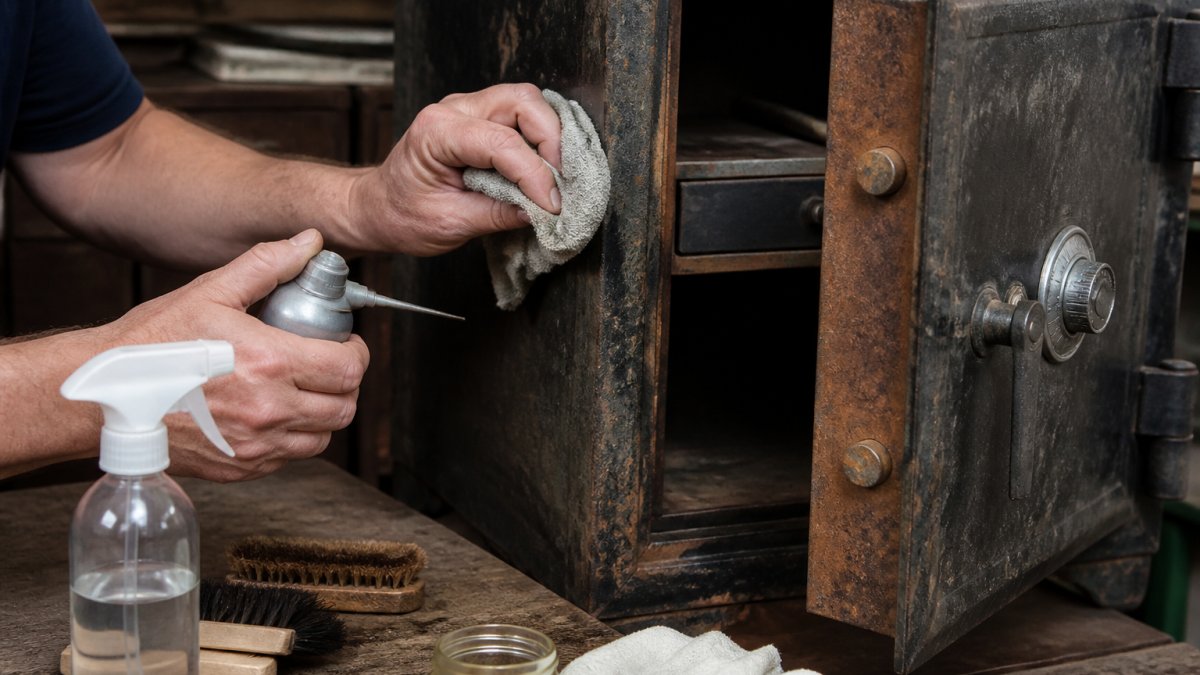
Examine the dial visually. Dark, sticky residue around the spindle or dial ring is old lubricant mixed with dust and corrosion; applying new lubricant on top only clogs the mechanism further.
Use a soft brush or compressed air to remove loose dust and debris around the dial. Avoid water or solvents unless you're certain the lock case won't be damaged, since many vintage safes have finishes harmed by aggressive cleaning.
For stubborn residue, apply a small amount of mineral spirits with a soft cloth, let it sit a minute or two, then wipe clean. Work slowly: rushing can force grime deeper into the mechanism.
Watch Out Never use WD-40 or heavy degreasers to clean a vintage safe dial. These products can dissolve paint, damage decals, and leave a residue that's harder to remove than what you started with. Stick to gentle mechanical removal and minimal solvent use.
WD-40 on Safe Locks: What You Should Know
WD-40 is tempting when a safe dial feels stiff, but it's not the best choice for vintage safe mechanisms.
WD-40 is a penetrating oil that displaces moisture and loosens rust, fine for rusted bolts and squeaky hinges. On vintage safe dials it's too thin and volatile, evaporating quickly, and its solvents can soften old paint and decals.
WD-40 also attracts dust more readily than purpose-built lock lubricants; over time that dust mixes into a gritty paste that increases friction. It's a temporary fix at best.
That said, if a dial is severely stuck, a small amount of WD-40 can break initial resistance before you apply a better lubricant, just clean it out thoroughly afterward and replace it with a more appropriate product.
Mechanical Safe Lock Lubrication: Dial vs. Boltwork
The dial mechanism and locking bolt mechanism are separate systems requiring different lubrication approaches.
Dial Mechanism Lubrication
The dial mechanism includes the spindle (the shaft the dial turns on), the dial ring (the numbered ring you rotate), and the internal cams and wheels that translate dial movement into lock signals. These must move smoothly for reliable opening.
Light oil is preferred for dial mechanisms. Apply a single drop to the spindle where it enters the lock case, rotate the dial several times to work it in, then wipe away excess. The goal is just enough lubricant to reduce friction without visible residue.

Some vintage safes have a dial ring removable from the front, letting you lubricate internal components directly. That requires careful disassembly, though, so if you're not confident, work from the spindle entry point instead.
Dry film lubricants are also effective for dial mechanisms if you prefer a cleaner approach. They reduce friction without the mess of oil, though they require more precision in application.
Lock Case and Boltwork Lubrication
The locking bolts are the heavy steel bars that extend into the safe's frame. They experience intermittent, high-force movement, so they don't need the smooth, continuous lubrication the dial does.
White lithium grease suits the boltwork because the bolts move less frequently and tolerate a slightly thicker lubricant. Apply a thin layer to the bolt surfaces where they extend and retract, and keep grease off the dial mechanism and spindle, which must stay clean and light.
The bolt guides and locking cam (which triggers the bolts) also benefit from light lubrication: a small amount of light oil or dry film lubricant reduces wear and keeps the bolts moving smoothly.
Key Takeaway The cardinal rule: keep the dial light and clean, and the bolts adequately but not excessively lubricated. Mixing these approaches, using heavy grease on the dial or nothing on the bolts, is where most maintenance problems start.
Safe Maintenance Schedule and Best Practices
Vintage safes don't need constant attention, but a regular maintenance schedule keeps them reliable and prevents the deterioration that leads to stuck dials and sluggish bolts.
Inspect the dial and boltwork every 6 to 12 months. Open and close the safe normally and note how the dial feels: smooth or resistant?
Apply lubricant only when you notice a problem, not on a fixed schedule. Over-maintenance is as bad as under-maintenance. If the dial turns freely and the bolts move smoothly, leave it alone.
When you do lubricate, apply sparingly: a single drop of light oil on the spindle is often enough, and a thin coat of grease on the visible bolt surfaces suffices. Wipe away any excess immediately.
Keep the safe in a clean, dry environment, since dust and humidity are enemies of vintage locks. In a basement or other damp location, consider a dehumidifier: moisture accelerates corrosion and breaks lubricant down faster.
Address corrosion on the dial or boltwork promptly. Light surface rust can be gently cleaned with a soft brush and minimal mineral spirits; heavy corrosion may require professional intervention to avoid further damage.
Recommended Products for Vintage Safe Dials
These products are options commonly recommended by professionals for vintage safe dial lubrication.
AeroShell 22
AeroShell 22 is a light machine oil formulated for precision mechanisms in aviation and industrial applications.
AeroShell 22 is designed for tight tolerances and precise mechanical operation: it won't gum up or leave heavy residue and lubricates consistently over time. The downside is it's harder to source than general-purpose lubricants and typically more expensive.
AeroShell 22 works best on the dial spindle and internal lock components. Apply a minimal amount and let normal dial rotation work it in; a small bottle of this professional-grade product lasts years.
Versilube
Versilube is a precision lubricant: a synthetic oil for metal components where smooth operation is critical.
Versilube is similar to AeroShell 22 in application and benefits: clean, dust-resistant, and long-lasting. Like AeroShell, it's a specialty product sourced from a locksmith supply house or online retailer.
Versilube is an excellent choice for dial mechanisms, especially if you want to avoid grease mess or the imprecision of spray lubricants.
GN Metal Paste
GN Metal Paste is a specialty lubricant: a paste-based product that stays in place and lasts longer than light oils.
GN Metal Paste suits the locking bolt mechanism and other intermittent components. Thicker than light oil but lighter than white lithium grease, it's a good middle ground for reliable lubrication without excessive residue buildup.
Apply GN Metal Paste sparingly to bolt surfaces and guides; a thin coat suffices. It's typically available through locksmith suppliers.
SIL-Glyde
SIL-Glyde is a silicone-based lubricant. It's sometimes used as a disc brake lubricant, which speaks to its precision and reliability under friction.
SIL-Glyde works on dial mechanisms and boltwork. Cleaner than grease and more durable than light oil, it's a good all-purpose option for vintage safes, though harder to find than mainstream lubricants.
If you can source SIL-Glyde, try it on a dial that needs lubrication but where you want minimal residue buildup.
When to Call a Safe Technician
Sometimes lubrication alone won't solve the problem, and forcing a stuck dial or boltwork can cause damage a professional must repair.
If the dial is completely immobile even under gentle pressure, don't force it. That usually means internal corrosion or a mechanical jam requiring disassembly. A safe technician can open the dial housing, inspect the components, and clean or repair the blockage.
Similarly, if the locking bolts won't extend or retract fully or stick partway, the problem likely goes beyond lubrication: corroded bolts, a damaged locking cam, or internal misalignment. These require professional diagnosis and repair.
If you're unsure whether lubrication will help, or the safe is particularly valuable or antique, consult a professional before attempting maintenance yourself.
Bay Safe and Lock can diagnose your vintage safe and recommend the right approach, whether professional lubrication and cleaning, component repair, or safe opening if the combination is lost.
Keeping a vintage safe in working condition requires the right lubricant, applied correctly, to the right components.
Frequently Asked Questions
What is the best lubricant for a vintage safe dial?
The best lubricant depends on your dial's material and age. Light oils like AeroShell 22 work well for metal components, while dry film lubricants reduce dust attraction. Avoid heavy greases that accumulate grime. When in doubt, consult a safe technician who can inspect the specific mechanism.
Should you lubricate a mechanical safe lock?
Yes, mechanical safe locks benefit from periodic lubrication to reduce friction and maintain smooth operation. However, the dial mechanism, lock case, and boltwork require different approaches. The dial spindle needs minimal lubrication applied sparingly, while the lock case may tolerate slightly more. Over-lubrication causes residue buildup and attracts dust and dirt, which damages the mechanism faster than dry operation.
Can WD-40 damage a vintage safe dial or lock?
WD-40 is a penetrating oil designed for short-term rust prevention, not long-term lubrication. On vintage safe dials, WD-40 can attract dust and grime, leading to sticky movement and corrosion.
How often should a mechanical safe lock be serviced?
If your dial moves slowly, sticks, or feels gritty, service it immediately rather than waiting for the scheduled interval. Regular maintenance prevents corrosion and extends the life of vintage safe locks.
NEED AN ESTIMATE FOR YOUR PROJECT? CLICK HERE

Comments