top of page

Table of Contents

  • Why Choosing the Right Commercial Locks Matters

  • ANSI/BHMA Lock Grades Explained

    • Grade 1 vs. Grade 2 vs. Grade 3

    • BHMA Certification and What It Means

  • Commercial Door Hardware Types

    • Mortise Locks vs. Cylindrical Locks

    • Exit Devices and Panic Bars

    • Deadbolts and Strike Plates

  • Fire-Rated Door Hardware Requirements

  • Access Control System Integration

    • Keyless Entry and Biometric Authentication

    • Master Key Systems and Credential Management

    • Cybersecurity Considerations for Smart Locks

  • Key Factors to Consider When Selecting Commercial Locks

    • Traffic Volume and Durability

    • Material and Weather Resistance

    • ADA Compliance and Accessibility

    • Total Cost of Ownership

  • Common Mistakes to Avoid

  • Conclusion

Last Updated: August 26, 2026

Why Choosing the Right Commercial Locks Matters

Selecting appropriate commercial locks shapes your facility's security posture, regulatory compliance, operational efficiency, and long-term costs. Poorly chosen systems create vulnerabilities, repeated rekeying, incompatible hardware, and replacement expenses that dwarf the original investment.

At Bay Safe and Lock, we've worked with facility managers, property owners, and business operators across diverse industries. Teams that invest upfront in understanding lock grades, hardware types, and integration requirements avoid costly mistakes. The stakes vary by property type, a retail storefront faces different threats than a medical facility or industrial warehouse, yet the fundamental framework remains the same: match your lock system to your specific traffic volume, security requirements, compliance obligations, and integration needs.

Pro Tip The most expensive lock system isn't always the best choice. The right system matches your specific facility's traffic patterns, security threats, and integration requirements. Oversizing creates unnecessary costs; undersizing creates security gaps.

ANSI/BHMA Lock Grades Explained

The ANSI/BHMA grading system is the foundation of commercial lock selection in the United States. These standards define how locks perform under specific stress conditions and establish a common language between security professionals, installers, and facility managers.

ANSI Grade 1 is the highest security classification. These locks undergo 1 million cycles of operation, 10 minutes of direct force application, and multiple picking attempts. Grade 1 locks are built for high-traffic environments where security is paramount: banks, government facilities, medical centers with restricted areas, and industrial sites handling sensitive materials.

ANSI Grade 2 handles 500,000 operational cycles and is designed for moderate to heavy commercial traffic. Most office buildings, retail stores, apartment complexes, and medical facilities operate successfully with Grade 2 hardware. Grade 2 locks balance durability, security, and affordability, making them the most common choice for general commercial applications.

ANSI Grade 3 supports 100,000 cycles and is suitable for light commercial use or areas with lower security requirements. Grade 3 is rarely the right choice for primary entrances or spaces requiring genuine security.

Grade 1 vs. Grade 2 vs. Grade 3

Grade

Cycle Rating

Force Resistance

Best For

Typical Cost Impact

Grade 1

1,000,000

10 min direct force

Banks, government, restricted medical areas

Highest

Grade 2

500,000

Moderate force

Offices, retail, apartment complexes, standard medical facilities

Moderate

Grade 3

100,000

Light force

Secondary doors, storage, low-traffic areas

Lowest

For most commercial properties, the decision comes down to Grade 1 versus Grade 2. Grade 1 is necessary when your facility has high-value assets, restricted access zones, or regulatory requirements that mandate the highest security level. Grade 2 is sufficient for most general commercial applications.

Watch Out Choosing Grade 3 for a primary entrance to save money almost always backfires. The operational lifespan is short, replacement costs come sooner, and the security gap creates liability. For primary commercial entrances, Grade 2 should be your minimum standard.

BHMA Certification and What It Means

The Builders Hardware Manufacturers Association (BHMA) administers the ANSI testing standards and certifies locks that meet those specifications. A BHMA-certified lock has been tested by an independent laboratory and proven to meet the grade's performance requirements. Always verify BHMA certification when evaluating locks. Certified locks carry documentation proving they've passed rigorous testing, and BHMA certification matters for compliance; regulatory standards typically reference ANSI/BHMA grades explicitly.

Commercial Door Hardware Types

Commercial locks come in distinct mechanical types, each with different installation requirements, security profiles, and integration capabilities.

Mortise Locks vs. Cylindrical Locks

Mortise locks are installed into a cavity routed into the door edge. The lock body sits inside the door, with only the face plate, handle, and keyway visible. Mortise locks are built heavier with more internal components and greater tamper resistance, common in high-security applications.

Cylindrical locks (also called pin tumbler locks) are the standard in modern commercial construction. The lock mechanism sits behind the door face in a cylindrical housing. Installation is straightforward: drill a hole through the door, insert the lock cylinder, and attach the escutcheon plate. Cylindrical locks are lighter, faster to install, less expensive, and integrate seamlessly with modern access control systems. For new construction or standard commercial applications, cylindrical locks are the default choice.

Close-up of commercial door hardware showing mortise lock mechanism installed in door edge alongside cylindrical lock assembly on adjacent door, with visible face plates, handles, and strike plates in a modern office building entrance

Exit Devices and Panic Bars

Exit devices (commonly called panic bars or crash bars) are required on certain doors by fire code. These horizontal bars run across the door's interior face. When pushed, they release the door latch, allowing rapid egress during emergencies. Exit devices must allow free egress at all times; you cannot restrict emergency exit doors with locks that prevent pushing the bar (nfpa.org).

Electronic exit devices can be integrated with access control systems, allowing facility managers to unlock or lock the door remotely and log exit events. Electronic exit devices require power and backup power (battery) to ensure they function during power outages.

Deadbolts and Strike Plates

Deadbolts are single-motion locks that extend a bolt into the strike plate when turned. Unlike spring latches, deadbolts remain extended until manually retracted with a key. On commercial doors, deadbolts are typically used in combination with lever handles.

Strike plates are the metal plates mounted on the door frame that receive the bolt or latch. The quality of the strike plate directly affects the lock's security. A weak strike plate can be kicked in even if the lock itself is strong. Commercial-grade strike plates are thicker, use longer screws that penetrate deep into the frame, and distribute force across a wider area.

Key Takeaway Exit devices, deadbolts, and strike plates are integral to your security system. A complete installation includes hardware that matches your lock grade and complies with fire codes.

Fire-Rated Door Hardware Requirements

Fire-rated doors are designed to resist fire spread and maintain structural integrity during a fire. They're required in certain locations by building codes: between units in apartment complexes, around stairwells, and between commercial tenants.

Fire-rated doors must be installed with fire-rated hardware, including locks, hinges, closers, and strike plates. This hardware is tested to ensure it doesn't compromise the door's fire-rating. Using standard commercial hardware on a fire-rated door voids the fire-rating and creates a code violation.

Fire-rated locks are available at all ANSI/BHMA grades. When specifying locks for fire-rated doors, confirm that the lock carries UL (Underwriters Laboratories) fire-rating certification (ul.com). The lock's label should indicate the fire-rating duration (typically 20, 45, or 90 minutes). If your facility includes fire-rated doors, work with a locksmith or security professional who understands fire-code requirements.

Access Control System Integration

Modern commercial facilities increasingly rely on access control systems that track who enters restricted areas, when they enter, and whether entry was authorized. These systems enable rapid credential revocation, audit trails for compliance, and integration with building security infrastructure.

Keyless Entry and Biometric Authentication

Keyless entry systems replace traditional keys with electronic credentials: key cards, fobs, mobile credentials, or PIN codes. When an authorized person presents a credential, the electronic lock mechanism releases the door. Keyless systems eliminate key duplication problems, enable rapid access revocation, and provide audit trails of entry events.

The most common commercial keyless system is the magnetic stripe or proximity card reader. Mobile credentials, a smartphone app or digital wallet that transmits credentials to the reader, are more secure, more convenient, and enable temporary access grants to contractors or visitors.

Biometric authentication (fingerprint, facial recognition, iris scanning) adds another security layer. Biometric systems authenticate based on unique physical characteristics that cannot be duplicated or shared. Facilities using biometric authentication typically maintain backup card readers or mechanical locks as fallback options.
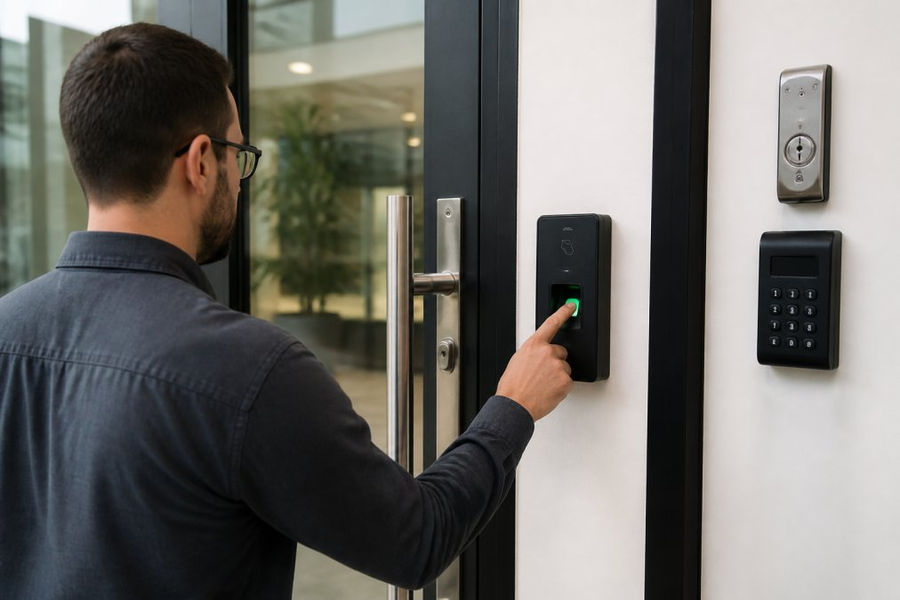
Security professional using biometric fingerprint reader at commercial building entrance, with electronic lock mechanism visible and access control panel mounted on wall, modern office setting with glass doors

Master Key Systems and Credential Management

Master key systems allow facility managers to control access across multiple locks with a hierarchy of keys. A master key opens all locks in the system. Individual keys open only their designated locks.

Modern electronic master key systems use software and electronic credentials to achieve the same hierarchy without mechanical complexity. The advantage is operational flexibility: a facility manager can change access permissions without physically rekeying locks, a contractor's access can be revoked by deleting their credential from the system, and temporary access for visitors can be granted for specific times and locations.

Cybersecurity Considerations for Smart Locks

Electronic locks and access control systems are connected devices. This connectivity creates cybersecurity risks that mechanical locks do not have. A compromised access control system could allow unauthorized entry, prevent authorized entry, or expose audit logs.

Protecting smart locks requires strong encryption for all wireless communications, role-based access controls in management software, regular firmware and software updates with security patches, and monitoring of access logs for suspicious patterns. When selecting smart lock systems, ask vendors about their security testing and incident response procedures.

Watch Out Smart locks are only as secure as their network infrastructure. A lock that communicates over an unencrypted wireless connection or connects to a poorly secured management system creates a security liability regardless of the lock's mechanical strength.

Key Factors to Consider When Selecting Commercial Locks

Beyond grades and hardware types, several practical factors determine whether a lock system will perform well in your specific facility.

Traffic Volume and Durability

High-traffic doors experience more wear than low-traffic doors. A lock rated for 500,000 cycles (Grade 2) will fail sooner on a door that experiences 5,000 daily openings than on a door with 50 daily openings. Estimate your facility's traffic volume by counting daily openings for critical doors. For typical office or retail environments, Grade 2 handles standard traffic well. For high-traffic public entrances or major medical facilities, Grade 1 is the appropriate choice.

Material and Weather Resistance

Locks exposed to weather, exterior doors, loading dock doors, or doors in humid environments face corrosion and material degradation. Standard commercial locks use brass or steel components. Brass resists corrosion better than steel but is softer and more expensive. Stainless steel components offer corrosion resistance and durability at higher cost. If your facility includes exterior doors or doors in corrosive environments, specify stainless steel or brass hardware.

ADA Compliance and Accessibility

The Americans with Disabilities Act (ADA) requires that commercial facilities provide accessible entry for people with disabilities. Door handles must be operable with a closed fist. Doors must open with no more than 5 pounds of force (ada.gov). Electronic locks must have manual backup mechanisms for people unable to use electronic credentials. Lever handles are ADA-compliant; knobs are not.

Total Cost of Ownership

The purchase price of a lock is only one component of total cost. Maintenance, replacement, integration with access control systems, and downtime from failures also matter. A cheap lock that fails after three years costs more than a quality lock with a ten-year lifespan. When evaluating locks, calculate total cost over the expected lifespan.

Common Mistakes to Avoid

Undersizing security for the facility type. A retail storefront or office building with Grade 3 locks invites theft and creates liability. Use Grade 2 as your baseline for any commercial facility with valuable assets or access restrictions.

Ignoring fire-code requirements. Fire-rated doors installed with standard locks create code violations and liability. Ensure all hardware carries fire-rating certification and meets building code requirements.

Mixing lock types without integration planning. A facility with both mechanical master key systems and electronic access control systems creates confusion and security gaps. Decide on a unified approach and implement it consistently.

Neglecting strike plate quality. A strong lock paired with a weak strike plate is a security failure. Upgrade strike plates to match lock grades and use screws that penetrate deep into the door frame.

Failing to account for traffic volume. Selecting a lock grade based on cost rather than traffic volume leads to premature failure and replacement. Estimate traffic honestly and choose hardware rated for that volume.

Treating cybersecurity as optional for smart locks. Electronic locks connected to networks require the same security discipline as any networked system. Weak passwords, unencrypted communications, and unpatched firmware create vulnerabilities.

Choosing commercial locks requires balancing security requirements, compliance obligations, traffic volume, and integration needs. The right system for your facility depends on what you're protecting, who needs access, and how your facility operates.

At Bay Safe and Lock, we help facility managers and business owners navigate these decisions with expertise grounded in over a decade of hands-on experience. Whether you're installing new hardware, retrofitting existing doors, or integrating access control systems, our team understands the technical requirements and can recommend solutions that match your specific facility's needs. We're licensed, fully insured, and federal level 2 background checked, ensuring that the security professionals managing your facility's access are trustworthy and qualified.

NEED AN ESTIMATE FOR YOUR PROJECT? CLICK HERE to connect with our team and discuss your commercial lock requirements.

Frequently Asked Questions

What are the differences between Grade 1 and Grade 2 commercial locks?

Grade 1 locks are the highest security rating under ANSI/BHMA standards and withstand extensive force and tampering. Grade 2 locks are slightly lower in security but still suitable for most commercial applications. Grade 1 is required for high-security facilities like banks and government buildings, while Grade 2 works well for retail stores, offices, and restaurants. The choice depends on your facility's security needs and traffic patterns.

Are commercial door locks different from residential locks?

Yes. Commercial locks are built for higher traffic, heavier use, and stricter security standards. They use ANSI/BHMA grading (residential locks do not), feature reinforced strike plates, and support master key systems for multi-unit facilities. Commercial locks also integrate with access control systems and must meet fire codes. Residential locks prioritize convenience and aesthetics over the durability and integration capabilities commercial locks provide.

How do I determine the fire rating requirements for my commercial doors?

Fire ratings depend on your building's occupancy type and local fire codes enforced by your jurisdiction. Life safety codes require specific fire-rated hardware on doors in stairwells, emergency exits, and between high-risk areas. Consult your local fire marshal or building department to identify which doors need fire-rated hardware. Door closers, exit devices, and locksets must all carry fire ratings matching your door's rating (typically 20, 45, 60, or 90 minutes).

What is the best commercial lock for high-traffic areas?

Grade 1 mortise locks are ideal for high-traffic areas due to their durability and tamper resistance. Pair them with heavy-duty strike plates and door closers to handle constant opening and closing. Keyless entry systems or access control integration work well in high-traffic facilities like hospitals and retail stores, reducing wear on mechanical components and improving security tracking. Material quality and regular maintenance extend lock life in demanding environments.

How does master key system integration work with commercial locks?

A master key system uses a hierarchy of keys: individual keys open single doors, sub-master keys open groups of doors, and the master key opens all doors. This system requires specialized mortise or cylindrical locks with matched pins. Master key systems are essential for property managers overseeing apartment complexes or multi-tenant buildings, allowing efficient access control without duplicating keys for every lock. Professional installation ensures the system functions securely.

What cybersecurity risks do smart commercial locks face?

Smart locks transmit credential data electronically, making them vulnerable to hacking if not properly secured. Choose systems with encryption, regular firmware updates, and audit trails that track access attempts. Avoid locks with outdated wireless protocols or weak password requirements. Pair smart locks with a comprehensive access control system that monitors for unusual activity. Hybrid systems combining mechanical and electronic security provide redundancy if one system fails.

NEED AN ESTIMATE FOR YOUR PROJECT? CLICK HERE

This article was written using GrandRanker


Table of Contents

  • Why Locksmith Services Matter for Small Business Security

  • How to Find a Reliable 24-Hour Locksmith

    • Verify Licensing and Insurance

    • Check Response Times and Availability

  • Commercial Lock Rekeying Services and Master Key Systems

    • When to Rekey vs. Replace Locks

    • Master Key System Design for Multi-Unit Properties

  • Understanding Commercial Locksmith Cost and Budgeting

    • Factors That Affect Pricing

    • Getting an Accurate Quote

  • High-Security Lock Upgrades and Access Control Integration

  • Emergency Lockout Services and Response Time Expectations

  • Door Hardware Maintenance and Lock Repair

  • Security Audits and Compliance for Small Businesses

Last Updated: August 23, 2026

Why Locksmith Services Matter for Small Business Security

Small business owners face a unique security challenge: they need enterprise-grade protection without enterprise-level budgets. A single break-in doesn't just cost money, it disrupts operations, damages customer trust, and can force a business to close temporarily or permanently. Locksmith services for small businesses address this gap by providing tailored security solutions that protect assets, employees, and customer data.

The stakes are real. A compromised entry point, lost key control, or outdated locks create vulnerabilities that grow more expensive to fix the longer they're ignored. This is where professional locksmith services become essential. Beyond simple lock repairs, modern locksmith services encompass master key system design, high-security hardware installation, access control integration, and emergency response, all scaled to fit a small business's actual needs and budget constraints.

Bay Safe and Lock understands this landscape. With over a decade of hands-on experience serving small businesses, commercial properties, and industrial facilities, the team delivers comprehensive security solutions that go beyond basic lock changes. Whether you're managing a retail storefront, medical facility, restaurant, or apartment complex, the right locksmith partnership transforms security from a reactive expense into a proactive asset.

How to Find a Reliable 24-Hour Locksmith

Finding a trustworthy locksmith requires more than a quick internet search. You're inviting someone into your business or home, someone who will have access to sensitive areas and information. The difference between a reliable professional and an unreliable one often comes down to verification, response capability, and transparent communication.

Verify Licensing and Insurance

Start with credentials. A legitimate locksmith holds a state license specific to locksmith work and carries liability insurance. Ask directly: "What's your license number?" and "Can you show me your insurance certificate?" Legitimate locksmiths have these readily available, they're not secrets.

Professional locksmith in uniform displaying state license and insurance documentation while standing at commercial building entrance in afternoon sunlight

Licensing requirements vary by state, but most require locksmiths to pass background checks, complete training hours, and demonstrate technical competency. Federal-level background checks go deeper. Bay Safe and Lock holds Federal Level 2 background clearance, which exceeds standard requirements and signals commitment to trustworthiness. When a locksmith mentions federal-level vetting, it's a meaningful differentiator, not all locksmiths pursue it.

Insurance matters equally. If a locksmith damages your door frame, lock, or property during installation or repair, their liability insurance covers the cost. Without it, you're absorbing the damage. Request proof of current coverage and verify the policy is active by calling the insurance company directly if you're uncertain.

Check Response Times and Availability

24-hour availability sounds standard but varies significantly in practice. Some locksmiths advertise 24-hour service but have long hold times or delayed dispatch. Ask specific questions: "What's your average response time for emergency calls?" and "Do you dispatch from a local office or rely on contractors?" Local dispatch typically means faster response because technicians are already in the area.

Response time expectations should be realistic. A locksmith who guarantees 15-minute response times everywhere is either overselling or will disappoint you when circumstances don't align with their promise.

Availability also includes how easily you can reach them. Can you call, text, or use an online booking system? Do they answer phones during off-hours or use automated systems? Direct communication with a human dispatcher reduces misunderstandings and gets your situation prioritized correctly.

Commercial Lock Rekeying Services and Master Key Systems

Rekeying and master key systems are foundational to commercial security. They solve two distinct but related problems: controlling who has access and managing keys efficiently across multiple locations or tenants.

When to Rekey vs. Replace Locks

Rekeying changes the internal mechanism of an existing lock so old keys no longer work. It's cost-effective and fast, typically completed in minutes. Replacement removes the entire lock and installs a new one. The choice depends on lock condition, security requirements, and budget.

Rekey when:

  • Locks are in good physical condition

  • You need to revoke access after a tenant moves out or employee leaves

  • You're consolidating keys for a master key system

  • Current locks meet your security needs but key control is compromised

Replace when:

  • Locks show visible wear, rust, or damage

  • You're upgrading to higher-security hardware

  • Current locks don't integrate with new access control systems

  • Locks are older and lack modern security features

For small businesses, rekeying is often the entry point into professional key management. It's affordable and demonstrates the value of controlled key distribution. As your business grows or security requirements increase, you can upgrade to higher-security locks or access control systems without starting from scratch.

Master Key System Design for Multi-Unit Properties

A master key system lets authorized personnel open multiple locks with a single key while allowing tenants or department heads to open only their designated areas. For apartment complexes, office buildings, or retail centers, this eliminates the need for dozens of individual keys and simplifies emergency access.

Designing a master key system requires precision. The wrong hierarchy creates security gaps or becomes unwieldy. A typical three-level system works like this:

  • Master key: Opens all locks (management only)

  • Sub-master keys: Open locks within a specific area or floor (building supervisor)

  • Change keys: Open individual units or spaces (tenants or employees)

The system must account for future expansion, staff turnover, and emergency scenarios. Bay Safe and Lock's approach includes mapping your property layout, identifying access zones, and recommending hardware that supports the hierarchy you need without overcomplicating key management.

Understanding Commercial Locksmith Cost and Budgeting

Cost is a legitimate concern. Small businesses operate on thin margins, and security expenses compete with payroll, inventory, and rent. Understanding what drives pricing helps you budget realistically and avoid surprises.

Factors That Affect Pricing

Several variables influence the final cost:

  • Service type: Emergency lockouts cost more than scheduled maintenance. After-hours service carries premium rates.

  • Hardware quality: Commercial-grade locks cost more than residential equivalents but last longer and offer better security.

  • Complexity: Rekeying a single lock takes 30 minutes. Designing and installing a master key system for 50 units takes days.

  • Quantity: Bulk rekeying or hardware installation benefits from volume pricing.

  • Travel distance: Locksmiths charge travel fees for distant locations or include it in their service area radius.

  • Urgency: Same-day service or emergency response typically costs more than scheduled work.

Getting an Accurate Quote

Request quotes from multiple locksmiths using the same specifications. Describe your exact needs: "We need to rekey 15 apartment units and design a master key system" or "We need high-security deadbolts and electronic access control on our retail storefront." Vague requests yield vague quotes.

A professional locksmith will ask clarifying questions before quoting: How many locks? What's the current hardware? What's your timeline? Do you need installation today or can it be scheduled? These questions ensure the quote reflects your actual situation.

When comparing quotes, don't automatically choose the lowest price. A suspiciously low quote often means the locksmith underestimated the work or plans to upsell you mid-project. Mid-range quotes from established locksmiths with verifiable credentials typically represent fair pricing. Bay Safe and Lock provides transparent, quote-based pricing tailored to your specific project, contact them directly for estimates rather than assuming standard rates.

High-Security Lock Upgrades and Access Control Integration

As small businesses grow or face increasing security threats, basic locks become insufficient. High-security lock upgrades and access control integration represent the next tier of protection, offering features that prevent unauthorized duplication, enable credential management, and provide audit trails.

High-security locks use restricted key blanks, keys that cannot be duplicated at standard hardware stores. The manufacturer controls distribution, so only authorized personnel can request duplicates. This prevents former employees or competitors from making unauthorized copies. High-security cylinders also resist picking, bumping, and drilling, techniques that compromise standard locks.

Locksmith technician installing high-security deadbolt and electronic access control panel on commercial glass door with focused lighting on hardware

Access control systems layer digital credential management on top of physical locks. Instead of keys, authorized personnel use keycards, key fobs, or biometric authentication (fingerprint, facial recognition). Systems log every entry, creating an audit trail that shows who accessed which areas and when. For medical facilities, restaurants, or retail stores handling sensitive information, this level of tracking is essential for compliance and security investigations.

Integration between physical locks and access control systems requires planning. Not all locks work with all systems. A professional locksmith evaluates your current infrastructure, recommends compatible hardware, and manages the installation so systems communicate properly. This is where experience matters, a locksmith who understands both mechanical security and electronic systems prevents costly compatibility issues.

Emergency Lockout Services and Response Time Expectations

Lockouts happen. An employee forgets a key, a tenant loses access, or a door malfunctions at the worst possible time. Emergency lockout services provide rapid response when you're locked out of critical areas.

Response time varies based on location, time of day, and current demand. Late-night or early-morning lockouts may take longer because fewer technicians are on duty. Rural locations or areas far from the locksmith's base may require 90+ minutes.

When you call for emergency service, provide clear information: your exact address, which door or lock is inaccessible, and why you need access (you're locked out vs. you need to access a space for a customer or emergency). This helps the dispatcher prioritize and send the right technician with appropriate tools.

Emergency service costs more than scheduled work, often 50-100% premium depending on time of day and urgency. Knowing this in advance prevents sticker shock. For businesses that experience frequent lockouts, investing in preventive measures (spare keys held by trusted personnel, access control systems, better key management) often pays for itself by eliminating repeat emergency calls.

Door Hardware Maintenance and Lock Repair

Locks are mechanical devices. They wear, accumulate dust, and eventually fail if neglected. Regular maintenance extends lock life and prevents failures that force emergency service calls.

Common maintenance tasks include:

  • Lubrication: Apply light machine oil or silicone-based lubricant to lock cylinders annually. This reduces friction and prevents sticking.

  • Cleaning: Remove dirt and debris from lock mechanisms. Compressed air works well for external locks.

  • Inspection: Check for visible damage, rust, or loose components. Tighten screws and hinges.

  • Testing: Verify locks operate smoothly. Stiff or resistant locks need attention.

Lock repair addresses specific problems: a key that doesn't turn, a lock that won't latch, or a cylinder that's damaged. A professional locksmith diagnoses the issue and recommends repair or replacement. Minor repairs (replacing worn springs, adjusting latches) are inexpensive. Major damage (broken cylinders, stripped mechanisms) often warrants replacement with new hardware.

For businesses, preventive maintenance reduces downtime and emergency costs. A simple annual inspection by a professional locksmith catches problems before they become critical. Bay Safe and Lock offers maintenance services that keep locks functioning reliably and identify security gaps before they become problems.

Security Audits and Compliance for Small Businesses

A security audit evaluates your current locksmith infrastructure and identifies vulnerabilities. For small businesses, audits often reveal gaps that weren't obvious, forgotten exterior doors, outdated locks, or key control issues that create risk.

A comprehensive security audit includes:

  • Perimeter assessment: Reviewing all entry points (doors, windows, gates) and their current locks.

  • Key management evaluation: Auditing how keys are distributed, stored, and tracked. Who has keys to what? Are old keys retrieved from departed employees?

  • Access control review: Assessing whether current systems (if any) meet your security needs and compliance requirements.

  • Compliance check: Verifying that your security infrastructure meets industry standards or regulatory requirements specific to your business type.

Compliance requirements vary by industry. Medical facilities must meet HIPAA standards for access control (hhs.gov). Restaurants handling payment information need PCI DSS compliance (pcisecuritystandards.org). Retail stores may have insurance requirements for locks and alarm systems. A locksmith familiar with your industry can identify compliance gaps and recommend solutions.

After an audit, the locksmith typically provides a prioritized recommendations list. Critical vulnerabilities get addressed first. Less urgent upgrades can be phased in over time, allowing you to budget security improvements rather than facing one large expense.

Small business security doesn't require choosing between affordability and protection. The right locksmith services provide scalable solutions that grow with your business, starting with basic rekeying and advancing to master key systems, high-security hardware, and access control integration as your needs evolve.

Bay Safe and Lock brings over a decade of hands-on experience to every project, combining licensed, fully insured, and federal-level background-checked technicians with specialized expertise in safe opening, custom fabrication, and comprehensive security design. Whether you're managing a retail storefront, apartment complex, medical facility, or industrial site, Bay Safe and Lock delivers tailored security solutions that enhance property protection and provide the peace of mind that comes from working with verified, reliable professionals.

NEED AN ESTIMATE FOR YOUR PROJECT? CLICK HERE to connect with Bay Safe and Lock and discuss your specific security requirements.

Frequently Asked Questions

Q: What services do commercial locksmiths provide for small businesses?

A: Commercial locksmiths provide lock installation, rekeying, master key system design, emergency lockout services, high-security lock upgrades, access control system integration, door hardware maintenance, and lock repair. They also conduct security audits to identify vulnerabilities and recommend solutions. For specialized needs, some locksmiths offer safe opening, key duplication with restricted blanks, and credential management systems to prevent unauthorized key copying.

Q: How do I verify if a locksmith is licensed and insured?

A: Ask for proof of current licensing from your state's licensing board and request an insurance certificate before work begins. Licensed locksmiths should carry general liability and workers' compensation insurance. Federal level 2 background checks provide additional verification of trustworthiness. Request references from other businesses and check online reviews on independent platforms. Legitimate locksmiths will provide documentation without hesitation.

Q: What factors affect commercial locksmith cost?

A: Commercial locksmith cost depends on the scope of work, number of locks, type of hardware needed, emergency vs. scheduled service, and system complexity. Rekeying multiple units costs more than single locks. High-security upgrades and access control integration increase pricing. Emergency calls outside business hours typically include surcharges. Request quotes from licensed providers to compare pricing for your specific project rather than assuming standard rates.

Q: How often should a business change its locks or rekey them?

A: Rekey locks when employees leave, access needs change, or keys are lost or compromised. Small businesses typically rekey annually or after significant staff turnover. Retail stores and restaurants may need more frequent changes due to higher employee turnover. Master key systems reduce rekeying frequency by allowing authorized personnel changes without lock changes. A security audit can determine your business's specific rekeying schedule based on asset protection needs and access patterns.

NEED AN ESTIMATE FOR YOUR PROJECT? CLICK HERE

This article was written using GrandRanker


Table of Contents

  • Why Key Management for Apartment Complexes Breaks Down Without a System

    • Manual Lockboxes vs. Organized Key Control

    • Liability, Unauthorized Access, and Resident Safety

  • Master Key System for Apartments: How It Works and When You Need One

    • Keying Hierarchy: Grand Master, Master, and Change Keys

    • Restricted Key Blanks: Stopping Unauthorized Duplication

    • Cost Considerations for Small vs. Large Complexes

  • Electronic Key Control Systems: Audit Trails and Real-Time Reporting

    • Electronic Key Cabinets and Biometric Authentication

    • Integration with Property Management Software and Work Orders

    • Smart Home and IoT Access: Where Electronic Control Is Heading

  • Key Management Policy Template: What Every Property Needs in Writing

    • Core Policy Elements: Issuance, Return, and Vendor Access

    • Legal and Compliance Requirements to Address by State

  • Staff Training and Onboarding for Secure Key Management

  • Best Practices for Key Organization and Ongoing Security

  • Conclusion

Last Updated: August 22, 2026

Why Key Management for Apartment Complexes Breaks Down Without a System

Key management for apartment complexes is the structured process of controlling, tracking, and auditing every physical key associated with a property, from unit keys and master keys to mailbox keys and mechanical room access. Without that structure, properties become liabilities.

At Bay Safe and Lock, we've worked with property managers across multi-unit residential properties for over a decade. Key chaos doesn't announce itself until something goes wrong: a maintenance tech leaves without returning a master key, a former tenant never surrenders their unit key, or a vendor copy circulates years after the contract ends. By then, the physical security of the entire building is compromised.

The National Apartment Association's guidance on property operations identifies key control as a foundational component of resident safety and operational risk management. It's not a nice-to-have. It's infrastructure.

Manual Lockboxes vs. Organized Key Control

Manual lockboxes mounted in a maintenance closet with unlabeled keys offer zero audit trail and no accountability. Anyone with access can remove a key without any record of who took it, when, or why.

Organized key control means every key has a designated location, unique identifier, check-out log, and designated person responsible for its return. Even a paper-based system is significantly more secure than a lockbox if consistently enforced.

Liability, Unauthorized Access, and Resident Safety

Unauthorized access is the core liability risk in residential property management. If a key is duplicated without authorization and used to enter a unit, the property owner faces potential civil liability for negligence in key control. Courts have held property managers responsible when inadequate key management contributed to security incidents.

Residents have a reasonable expectation that their unit is secure. Meeting that expectation requires documented proof that key issuance, retrieval, and access are actively managed.

Master Key System for Apartments: How It Works and When You Need One

A master key system for apartments is a hierarchical lock architecture in which individual keys open only their assigned unit, while master keys open multiple units within a defined group, and grand master keys provide access to the entire property. This structure eliminates the need for maintenance staff to carry dozens of individual keys while still limiting access by role.

A locksmith's hands organizing a set of labeled master keys and change keys on a key ring, laid out on a workbench with a key cabinet visible in the background

Keying Hierarchy: Grand Master, Master, and Change Keys

The standard hierarchy for apartment complexes runs three levels:

  1. Change keys, open a single unit only. Issued to residents.

  2. Master keys, open all units within a building or zone. Issued to maintenance staff.

  3. Grand master keys, open every lock in the entire complex. Held by property management leadership only.

Some larger properties add a fourth level: sub-master keys that cover a specific wing, floor, or building within a larger campus. The hierarchy should reflect your operational structure. A 20-unit complex rarely needs more than two levels. A 300-unit community with multiple buildings almost certainly needs four.

Restricted Key Blanks: Stopping Unauthorized Duplication

The most common failure in apartment key management is unauthorized duplication. A resident takes their change key to a hardware store, makes a copy, and that copy circulates indefinitely, even after the original key is returned at move-out.

Restricted key blanks solve this directly. A restricted key blank is a proprietary key profile that hardware stores cannot legally stock or duplicate without authorization from the issuing locksmith or manufacturer. For property managers asking whether restricted keys are worth the added cost: the answer is almost always yes, because the alternative is rekeying units every time a key is unaccounted for.

Cost Considerations for Small vs. Large Complexes

The cost of a master key system scales with unit count, but not linearly. A small complex of 10-20 units typically requires a straightforward two-level hierarchy with modest hardware costs. Larger complexes with 100+ units see lower per-unit hardware costs but increased system design, installation labor, and ongoing management overhead. At that scale, the business case for electronic key control alongside the physical master key system becomes compelling.

Pricing depends on the number of cylinders, hardware grade, whether restricted blanks are specified, and keying hierarchy complexity. Contact Bay Safe and Lock directly for an accurate estimate based on your property's specific configuration.

Electronic Key Control Systems: Audit Trails and Real-Time Reporting

Electronic key control systems replace paper logs with automated, time-stamped records of every key issuance and return. The audit trail these systems generate is the single most important operational and liability management tool available to property managers at scale.

A paper log can be falsified, lost, or ignored. An electronic system with biometric authentication cannot be circumvented without leaving a record.

A property manager reviewing a digital key log on a desktop computer screen inside a well-lit apartment complex management office, with an electronic key cabinet mounted on the wall behind them

Electronic Key Cabinets and Biometric Authentication

An electronic key cabinet is a wall-mounted unit that stores physical keys in individually locked slots, releases them only after authenticated access, and logs every transaction automatically. Authentication methods range from PIN codes to proximity cards to biometric authentication via fingerprint or retinal scan.

Biometric authentication is the most secure option because it eliminates credential sharing. A PIN can be passed between employees. A fingerprint cannot. Key retrieval typically takes under 30 seconds, with the system recording user identity, key taken, and timestamp.

Integration with Property Management Software and Work Orders

The most operationally efficient setups integrate electronic key control directly with property management software and work order systems. When a maintenance technician receives a work order, the system can automatically authorize key retrieval for that specific unit within the work order window. When the job closes, key return is logged against the same record.

This integration closes the gap that manual systems leave open: the period between key issuance and return, during which the key's location and use are unverifiable. According to the Building Owners and Managers Association's operational standards, documented access control procedures are a recognized component of building operations best practice.

Smart Home and IoT Access: Where Electronic Control Is Heading

The boundary between physical key management and digital access control is dissolving. Smart locks, IoT-connected access points, and mobile credential systems now allow property managers to issue, revoke, and audit unit access without a physical key changing hands at all.

This changes the architecture of the problem. Instead of managing physical keys for resident access, the physical key system can be reserved for staff and emergency access only, while residents use app-based credentials or key fobs. The master key hierarchy remains essential for maintenance and emergency scenarios, but its scope narrows.

Key Management Policy Template: What Every Property Needs in Writing

A written key management policy is the document that turns good intentions into enforceable procedures. Without it, every decision about key issuance, vendor access, and lost key protocols is made ad hoc and without documentation.

Key Management Policy, Core Elements

  • Key issuance log: Every key issued must be recorded with the recipient's name, unit or access level, date issued, and issuing staff member.

  • Resident key agreement: Residents sign a key receipt at move-in acknowledging the number of keys issued and the consequences of non-return.

  • Master key access list: Identify by name and role every person authorized to hold a master key. Review and update this list quarterly.

  • Vendor access protocol: All vendor key issuances require a work order reference number, a scheduled return time, and a signed receipt.

  • Lost key procedure: Define the response timeline and rekeying threshold for reported lost keys. Specify who authorizes emergency rekeying.

  • Key return at move-out: Define the process for key collection at lease termination and the fee structure for unreturned keys.

  • Audit schedule: Conduct a full key inventory reconciliation at minimum quarterly, and after any security incident.

Core Policy Elements: Issuance, Return, and Vendor Access

The three highest-risk moments in any key management cycle are issuance, return, and vendor access. Issuance without a signed receipt creates no accountability. Return without physical verification creates phantom keys. Vendor access without a time-bound, logged protocol is the most common source of unauthorized access in residential properties.

Legal and Compliance Requirements to Address by State

Key management intersects with landlord-tenant law in ways that vary by state. Most states with active landlord-tenant statutes impose obligations around rekeying between tenancies. Several states, including California, Texas, and Florida, have specific statutory requirements about rekeying unit locks when a new tenant takes possession.

Property managers should verify their state's current requirements directly through their state's landlord-tenant statute or with a qualified attorney. The Uniform Residential Landlord and Tenant Act resources provide a useful baseline, but individual state law governs and changes regularly.

Watch Out Failing to document rekeying between tenancies exposes property owners to civil liability if a subsequent tenant experiences a security incident. A signed rekeying record is your primary defense.

Staff Training and Onboarding for Secure Key Management

Policy documents don't protect properties. People following policy documents do. Staff training is where key management programs succeed or fail in practice.

Onboarding for any employee with key access should cover the property's key hierarchy and what each level authorizes, the check-out and check-in procedure in detail, and the escalation protocol for lost, unaccounted-for, or potentially duplicated keys. This training should be documented, with a signed acknowledgment from each employee.

A common failure mode is treating key management training as a one-time event. Build an annual key management review into your operational calendar.

Pro Tip Assign a single named key custodian for each shift or building. Diffused responsibility means no one owns the problem. A named custodian creates clear accountability for daily key reconciliation.

When something doesn't add up, staff need to know the exact steps: report immediately, do not wait until morning, and document the discrepancy in writing. The speed of response to a missing key is directly proportional to the reduction in security risk.

Best Practices for Key Organization and Ongoing Security

The operational discipline of key organization is where most properties fall short. The hardware and policy can be excellent, but if keys are stored inconsistently, labeled ambiguously, or audited infrequently, the system degrades.

Practice

Frequency

Impact

Full key inventory reconciliation

Quarterly

Identifies missing or unaccounted keys before incidents occur

Master key holder list review

Quarterly

Removes access for departed staff and role changes

Rekeying at tenant turnover

Every tenancy

Eliminates unauthorized duplication risk from prior occupants

Vendor key log audit

Monthly

Confirms all issued keys have been returned

Staff key management training

Annually + at onboarding

Maintains procedural compliance across team changes

Electronic system log review

Weekly

Detects anomalous access patterns early

Beyond the schedule, a few organizational principles matter consistently:

  • Label every key unambiguously. A key labeled "Unit 14B" is more secure than one labeled "spare."

  • Never mix key levels in storage. Grand master keys should never share a hook or drawer with change keys.

  • Treat a lost master key as a security incident, not an inconvenience. The response should be immediate, documented, and may require rekeying the affected zone.

  • Audit after personnel changes. Verify that all keys assigned to departing staff have been returned before the departure is finalized.

Key Takeaway The most effective key management programs treat key accountability as an ongoing operational discipline, not a one-time setup task. The audit schedule is as important as the hardware.

Keeping physical security tight across a multi-unit property requires more than good locks on the doors. The full key management lifecycle, from master key system design to electronic audit trails to written policy and staff training, demands coordinated, documented, and consistently enforced processes. Bay Safe and Lock brings over a decade of hands-on experience designing and implementing master key systems, restricted key blank programs, and access control solutions for residential and commercial properties. Our team is licensed, fully insured, and federal level 2 background checked, so property managers can trust who they're letting into their building. Get an accurate estimate for your property's key management setup, contact Bay Safe and Lock today.

Frequently Asked Questions

How does a master key system work for apartment buildings?

A master key system uses a keying hierarchy where individual unit keys open only one door, while a master key opens all units within a defined group. A grand master key sits above that, giving access to every lock in the building. Each level is cut to precise specifications so the keys cannot interchange accidentally. A licensed locksmith designs the system around your specific hardware, ensuring that rekeying one unit does not require changing the entire complex.

What are the best practices for managing keys in multi-unit properties?

Effective key management for apartment complexes starts with a written policy covering issuance, return, and vendor access. Number and tag every key to its corresponding unit, log every transaction, and conduct quarterly audits to confirm all keys are accounted for. Restrict who can authorize key duplication, and rekey any unit immediately after a tenant moves out. Electronic key cabinets add automated logging, which removes the risk of manual record errors and provides a clear audit trail if a dispute arises.

What are the benefits of electronic key control systems over traditional lockboxes?

Electronic key control systems replace passive lockboxes with active accountability. Every key retrieval is logged with a timestamp and the identity of the person who accessed it, creating a real-time audit trail. Access can be restricted by role, time of day, or specific key ring, and managers receive alerts when a key is not returned on schedule. Traditional lockboxes offer none of this visibility, making it harder to identify who had unit access during a security breach or maintenance dispute.

How much does setting up a master key system cost for a small apartment complex?

Pricing for a master key system depends on the number of units, the existing hardware, and whether rekeying or full lock replacement is needed. A 15-unit complex typically requires less hardware investment than a 100-unit building, but the per-unit cost can be higher when existing locks are incompatible with the chosen key system. Contact Bay Safe and Lock directly for an estimate tailored to your property's specific hardware and layout.

What legal considerations apply to key access in residential leases?

Landlord-tenant laws vary by state, but most require that property managers provide residents with keys or access credentials at move-in and rekey units between tenancies. Some states, including Florida and California, have specific statutes governing how quickly a landlord must rekey after a tenant request or after a domestic violence situation. Maintaining a documented key audit trail protects you if a tenant claims unauthorized entry. Consult your state's landlord-tenant statute and a licensed locksmith familiar with local compliance requirements.

Will switching to restricted key blanks actually prevent unauthorized duplication?

Restricted key blanks are manufactured to proprietary specifications and sold only through authorized dealers, which means a hardware store or generic key kiosk cannot copy them. This significantly reduces unauthorized duplication compared to standard key blanks. The system works best when combined with a written policy requiring manager authorization for any duplicate request and a log tracking every copy issued. Restricted blanks are not foolproof if the authorization process is not enforced consistently.

NEED AN ESTIMATE FOR YOUR PROJECT? CLICK HERE

This article was written using GrandRanker


Rosemary M.

Dan from Bay Safe - great worker, highly professional and super intelligent!!!

Adam G.

Had my safe opened and repaired in no time flat. Very satisfied with their professionalism.

Anthony R.

I can tell you've been doing this for a long time.
Bay Safe & Lock QR code

        Hello, from Bay Safe & Lock

My wife, Hayley and daughters, Jane and Eden. Our faith and values inspire a strong desire to serve others with excellence. A daily prayer in our home is that the Lord would bless us with grace, success and prosperity in direct proportion to our integrity. 

Colossians 3:23

bottom of page