top of page

Table of Contents

  • Verify Locksmith Credentials and Licenses

  • Check Physical Address and Local Service Area

  • How to Find a Reliable 24-Hour Locksmith

  • Read Customer Reviews and Testimonials

  • Understand Average Cost of Residential Locksmith Services

  • How to Spot Locksmith Scams

  • Questions to Ask Before Hiring and Post-Service Verification

  • Frequently Asked Questions

Last Updated: October 2, 2026

Verify Locksmith Credentials and Licenses

The first step in how to choose a residential locksmith 2026 is confirming they hold the proper credentials. A licensed locksmith has met state and local requirements, passed background checks, and carries liability insurance. This verification protects you from unlicensed practitioners who may damage your property or compromise your security.

Ask any locksmith for their license number and verify it directly with your state's licensing board or local regulatory agency. Most states require locksmiths to complete apprenticeships, pass exams, and maintain continuing education. Some jurisdictions also mandate Federal level 2 background checks, which screen for felonies and financial crimes, a strong indicator of trustworthiness.

Close-up of hands holding a locksmith license and insurance certificate against a desk with business documents and official paperwork

Request proof of insurance as well. Bonded and insured locksmiths carry coverage that protects your home if something goes wrong during service. A locksmith who hesitates to share these documents is a red flag. At Bay Safe and Lock, we maintain Federal level 2 background checks and full insurance coverage.

Pro Tip Call your state's licensing board before hiring. Many locksmiths claim credentials they don't actually hold. A quick 5-minute verification call saves you from potential scams and ensures you're working with a legitimate professional.

Check Physical Address and Local Service Area

Legitimate locksmiths operate from a physical business address, not just a phone number or website. A real office signals stability, accountability, and local roots. Before hiring, verify the business address on Google Maps and check that it matches their website and license records.

Call the business directly at a listed phone number and ask about their service area. When learning how to choose a residential locksmith 2026, prioritize one who serves your neighborhood and understands local building codes, common lock types in your area, and typical security concerns for homes in your region. They can also provide faster response times for emergencies.

Be cautious of locksmiths advertising only through third-party apps or aggregator sites. While some legitimate businesses use these platforms, scammers often operate exclusively through them to avoid accountability. Cross-reference any locksmith's business name and address across multiple sources before committing.

Key Takeaway A legitimate locksmith maintains a verifiable physical location, consistent phone number, and clear service boundaries. These are baseline markers of a professional operation.

How to Find a Reliable 24-Hour Locksmith

Emergency lockouts happen at inconvenient times. When you need how to find a reliable 24-hour locksmith, response time becomes critical. Ask potential locksmiths about their availability and typical response times for residential calls in your area. Many charge premium rates for after-hours service, so clarify pricing before an emergency occurs.

Request references from recent residential clients. Ask how quickly the locksmith arrived and whether the service resolved the problem on the first visit. A locksmith with consistent positive feedback about emergency response is more likely to help when you're locked out at midnight.

Check online reviews specifically for comments about availability and speed. Patterns matter more than individual reviews. If multiple customers mention waiting hours for a locksmith who claims 24-hour service, that's a warning sign. Look for businesses that maintain consistent, rapid response across different times of day and days of the week.

Read Customer Reviews and Testimonials

Customer testimonials reveal how a locksmith actually performs under real conditions. Read reviews on Google, the Better Business Bureau, and industry-specific platforms. Look for detailed feedback that describes specific services, rekeying, lock installation, emergency lockouts, rather than vague praise.

Pay attention to how the locksmith responds to negative reviews. A professional business addresses complaints respectfully and offers solutions. A locksmith who ignores criticism or responds defensively may not prioritize customer satisfaction. This pattern often predicts poor service if you encounter an issue.

Watch for review patterns. One negative review among dozens of positive ones is normal. Multiple recent complaints about the same problem, overcharging, property damage, slow response, indicate a systemic issue. Conversely, consistent praise for specific qualities like professionalism, expertise, or fair pricing suggests reliable service.

Watch Out Fake reviews exist. Be skeptical of accounts with minimal activity, generic praise ("Great service!"), or reviews posted all at once. Authentic customer feedback includes specific details and spans months or years.

Understand Average Cost of Residential Locksmith Services

Locksmith pricing varies widely based on the service type, time of day, and complexity. Common residential services include emergency lockouts, key duplication, lock rekeying, deadbolt installation, and lock repair. Each service carries different labor and material costs.

Understanding typical price ranges helps you identify overcharging and evaluate estimates fairly.

When requesting an estimate, ask the locksmith to itemize costs separately: service call fee, labor hours and rate, parts or hardware, and any trip charges. A written estimate should specify exactly what work will be performed and what each component costs. Be cautious of estimates that lump everything into one vague total or quote significantly lower than expected, this often signals either inexperience or a bait-and-switch tactic where the final bill is much higher.

Factors that increase costs include high-security locks (which use restricted keyways and cost-resistant cylinders), master key systems, access difficulty (locks on upper floors or in hard-to-reach locations), and whether the locksmith must remove and replace hardware versus adjusting existing mechanisms. If a locksmith recommends a service that seems expensive, ask why it's necessary and whether a less costly alternative would solve your problem.

Pro Tip Get estimates from at least two locksmiths before committing to major work like lock replacement or smart lock installation. Comparing itemized estimates helps you spot outliers and understand what you're paying for.

How to Spot Locksmith Scams

Locksmith scams target homeowners in urgent situations, locked out, needing emergency service, or facing security concerns. Common red flags include locksmiths who quote low prices over the phone, then charge significantly more on-site. Others damage locks unnecessarily to justify expensive replacements.

Avoid locksmiths who arrive in unmarked vehicles, refuse to provide written invoices, or demand cash-only payment. Legitimate businesses accept multiple payment methods and provide documentation. Scammers often use generic business names that mimic local or national brands, making them hard to distinguish from real companies.

Be wary of locksmiths who pressure you into unnecessary services like "security upgrades" or "system installations" you didn't request. A trustworthy locksmith assesses your actual needs and recommends only essential work. If a locksmith suggests expensive replacements when repair would solve the problem, seek a second opinion.

Watch Out Never hire a locksmith who arrives before you've confirmed their identity. Ask for their license number and call their business directly to verify they're actually en route. Scammers impersonate legitimate locksmiths to gain entry to homes.

Questions to Ask Before Hiring and Post-Service Verification

Before hiring, ask these critical questions: Are you licensed in this state? Can you provide proof of insurance and bonding? What is your service call fee?

Ask about their experience with your specific lock type or security need.

After the locksmith completes the work, verification is just as important as hiring the right professional. Before paying, perform these checks:

Lock Operation: Test each lock multiple times with the new key. Locks should turn smoothly without binding, grinding, or requiring excessive force. If a deadbolt sticks or the key feels rough, ask the locksmith to adjust it on the spot. For smart locks, test the keypad, app control, and backup key operation to ensure all functions work as expected.

Strike Plate Alignment: Open and close the door several times while watching the bolt.

Key Fit and Duplication: Test the new key in all locks it's supposed to open.

Hardware Security: If deadbolts or other hardware were installed, verify that all screws are tight and the hardware sits flush against the door.

Documentation and Warranty: Request a written invoice itemizing labor, materials, and any charges. The invoice should match the estimate provided beforehand.

Insurance and Claim Records: If you had a lockout or security incident that prompted the service, keep all documentation for your homeowner's insurance.

Smart Lock Documentation: If a smart lock was installed, ask the locksmith to walk you through the app setup, battery replacement procedures, and any firmware updates required.

Watch Out If the locksmith refuses to test the work with you or becomes defensive when you ask questions, this is a red flag. Legitimate professionals welcome verification and stand behind their work.

Pro Tip Request the locksmith's contact information and ask about their callback policy. If an issue arises within the warranty period, a responsive locksmith should address it promptly at no additional cost.

Frequently Asked Questions

How do I verify if a residential locksmith is licensed and insured?

Ask the locksmith for their state license number and insurance certificate before work begins. Contact your state's licensing board to confirm the license is active and in good standing. Request proof of bonding and liability insurance, reputable locksmiths keep this documentation readily available. Never hire someone who refuses to provide credentials or claims they don't need licensing. A licensed professional shows they've passed background checks and meet industry standards.

What are the main red flags of a locksmith scam?

Watch for locksmiths who quote extremely low prices, arrive in unmarked vehicles without company branding, refuse to provide written estimates, demand cash-only payment, or quote one price then demand significantly more after starting work. Scammers often advertise generic phone numbers instead of business addresses. If a locksmith pressures you into unnecessary services like rekeying the entire house when you only need one lock fixed, that's a warning sign. Always verify the company's physical address and phone number independently before calling.

How much should I expect to pay for residential locksmith services in 2026?

Residential locksmith costs vary based on the type of service, time of day, and complexity of the job. Emergency after-hours calls typically cost more than daytime appointments. Simple services like key duplication may be less expensive than deadbolt installation or rekeying multiple locks. Request a written estimate before work begins, and ask whether the quote includes labor, parts, and any service call fees. Pricing depends on your specific needs, contact Bay Safe and Lock for a current estimate tailored to your project.

What should I ask a locksmith before hiring them for residential work?

Ask about their experience with your specific lock type, whether they carry the parts needed on their first visit, their response time for emergencies, and what warranty they offer on parts and labor. Request references from recent residential clients and ask if they provide written invoices documenting all work completed. Confirm they're bonded and insured, ask about their cancellation policy, and clarify whether they offer 24-hour service if you need emergency lockout help. Getting answers upfront prevents surprises and ensures you hire a professional who matches your needs.

NEED AN ESTIMATE FOR YOUR PROJECT? CLICK HERE


Table of Contents

  • Assess Your Security Needs and Risk Level

  • Understand UL Burglary Ratings for Safes

  • Fire Protection vs. Burglary Resistance: What Your Business Needs

  • Electronic vs. Mechanical Safe Locks: Which Is Right for You?

  • How to Anchor a Safe to Concrete and Install It Properly

  • Choosing the Right Size, Capacity, and Safe Type for Your Business

  • Insurance Compliance and Maintenance for Commercial Safes

  • Frequently Asked Questions

Last Updated: October 1, 2026

Assess Your Security Needs and Risk Level

Learning how to choose a commercial safe for small business starts with understanding what you're actually protecting. Before you look at features, ratings, or price tags, you need to answer one fundamental question: what's the real threat to your business?

Most small business owners jump straight to shopping for safes without doing this critical first step. They end up with either overkill that costs thousands more than necessary, or inadequate protection that leaves them vulnerable. The difference between these outcomes is a simple risk assessment.

Start by identifying your assets. Are you protecting cash, documents, inventory, customer data, or a combination? How much cash moves through your business daily? What documents are irreplaceable, client records, contracts, proprietary formulas? For retail stores and restaurants, daily cash handling is often the primary concern. For professional services, it might be client files or intellectual property. For medical facilities, it's compliance records and restricted access logs.

Next, assess your actual threats. Internal theft is statistically more common than external burglary for small businesses. Do you have employees with safe access? How many? What's your turnover rate? A business with high employee turnover faces different risks than one with a stable, long-term team. External threats vary by location, a ground-floor retail space faces different burglary risks than an office in a secured building.

We help business owners evaluate these factors to determine the right security level. Document your answers: asset value, asset type, employee access patterns, location security, and insurance requirements. This assessment becomes your blueprint for everything that follows.

Pro Tip Before shopping, calculate your total asset value at risk. This number determines your minimum insurance requirement and guides your safe selection. Many businesses underestimate this, then discover their insurance won't cover losses because the safe wasn't adequate.

Understand UL Burglary Ratings for Safes

UL-rated safes carry a certification that tells you exactly how long they're designed to resist burglary attempts under standardized conditions. Understanding these ratings is non-negotiable when you're choosing a commercial safe for small business.

The Underwriters Laboratories (UL) standard defines burglary resistance through two key metrics: the time the safe can withstand attack and the tools used in that attack. A TL-15 rated safe, for example, resists forced entry for 15 minutes using common hand tools and power tools. A TL-30 resists for 30 minutes. Higher ratings like TL-30X40 and TRTL-30X6 add additional layers, X indicates resistance to torch attacks, and the second number represents minutes of resistance to that specific threat.

For small businesses, TL-15 and TL-30 are the most common choices. A TL-15 is adequate for businesses storing modest amounts of cash or standard documents. It's less expensive and takes up less floor space. A TL-30 is the standard for businesses handling significant daily cash or high-value inventory. The 15-minute difference in resistance time matters more than it sounds, it's the difference between a burglar deciding your safe isn't worth the effort.

The rating system also accounts for the safe's construction. A UL-rated safe must have a hardplate protecting the lock mechanism, hardened steel bolt work, and a composite construction that resists drilling and cutting. These aren't marketing features, they're minimum standards enforced by testing.

Watch Out A safe without a UL rating offers no verified protection level. Many inexpensive safes claim "burglary resistance" without any third-party testing. Your insurance company likely won't recognize them, and if you're burglarized, you'll discover the hard way that the safe provided no real protection.

Fire Protection vs. Burglary Resistance: What Your Business Needs

Here's where most small business owners face a genuine dilemma: the safes that protect best against burglary often provide minimal fire protection, and vice versa. Understanding this trade-off is essential to knowing how to choose a commercial safe for small business.

SafeandVaultStore

Fire-resistant safes use thick insulation, sometimes 4 inches or more, to keep internal temperatures below 350 degrees Fahrenheit during a fire. This works because the insulation absorbs heat. The downside: all that insulation makes the safe heavier, bulkier, and harder to anchor. A fire-rated safe rated to protect documents might weigh 600-800 pounds. A burglary-resistant safe of equivalent value protection might weigh 300 pounds.

Burglary-resistant safes prioritize hardened steel, reinforced doors, and complex locking mechanisms. They're built to resist tools and force. But steel conducts heat. A TL-30 rated safe in a structure fire can reach dangerous internal temperatures within minutes.

The answer isn't to choose one or the other, it's to choose based on your actual risk. If your business is in a building with active fire suppression systems and you're primarily concerned about employee theft or burglary, prioritize burglary resistance. If you're in an older building, store irreplaceable documents, or operate in a high-fire-risk area, fire protection becomes critical.

Many businesses solve this by using two safes: a smaller burglary-resistant safe for daily cash handling and access control, and a larger fire-resistant safe for documents and backup records. This approach costs more upfront but provides comprehensive protection. We often recommend this dual-safe strategy for businesses with mixed asset types.

Electronic vs. Mechanical Safe Locks: Which Is Right for You?

The locking mechanism you choose affects daily usability, audit trails, and long-term maintenance. Both electronic keypads and mechanical locks have legitimate advantages, the right choice depends on your workflow and compliance needs.

Electronic locks offer speed and access control. An electronic keypad lets multiple employees open the safe without sharing a physical key. You can change access codes without rekeying. Most importantly, electronic locks create an audit trail, a record of who accessed the safe and when. For businesses subject to compliance audits, this audit trail is often required.

The trade-off: electronic locks require batteries or power. If the battery dies and you don't have a backup, you're locked out. Electronic mechanisms can fail, and repair or replacement typically requires a technician. For small businesses with limited IT support, this becomes a real operational headache.

Mechanical locks are simple and reliable. No batteries, no electronics, no audit trail. A mechanical combination can be changed by a locksmith, but the process takes time and cost. Only one person typically knows the combination, which creates a single point of failure if that person leaves the business.

For most small businesses, an electronic keypad is the better choice. The access control and audit trail benefits outweigh the battery maintenance. However, you need a backup plan: a mechanical override, spare batteries stored on-site, or a service agreement with a locksmith who can respond quickly if the lock fails.

Pro Tip If you choose an electronic lock, test the battery backup system quarterly. Many businesses discover their backup system doesn't work when they actually need it. A simple test takes 5 minutes and prevents a costly emergency.

How to Anchor a Safe to Concrete and Install It Properly

A safe sitting on a floor can be stolen. Proper installation means anchoring the safe to the structure, typically concrete, so it can't be moved. This step is often overlooked by small business owners, and it's a critical vulnerability.

Professional technician securing anchor bolts into concrete floor with power drill, showing proper installation technique with hardened steel bolts and concrete anchors in commercial setting

The standard method uses anchor bolts that extend through the safe's base and into the concrete floor. The bolts must be hardened steel, regular bolts can be cut. Concrete anchors secure the bolts in place. The safe's footprint determines bolt placement; most commercial safes have four anchor points, though larger safes may have six or eight.

Installation requires proper equipment: a concrete drill with a bit sized for your anchor bolts, a torque wrench to tighten bolts to specification, and concrete anchors rated for your safe's weight. Improper installation, using undersized bolts, inadequate anchors, or incorrect torque, leaves the safe vulnerable to theft.

The installation location matters as much as the installation method. A safe bolted to a concrete floor in a room with a door is more secure than one in an open area. The floor itself must be structurally sound, a safe bolted to a deteriorating floor can be pried out. For second-floor installations, verify the floor can support the safe's weight plus the dynamic forces from attempted theft.

We handle commercial safe installation for businesses throughout the area.

Choosing the Right Size, Capacity, and Safe Type for Your Business

Safe size and capacity determine what you can actually store and how much space it occupies. This is where the practical constraints of your business become real.

Insurance Compliance and Maintenance for Commercial Safes

Your insurance policy likely includes specific requirements for how you store valuable assets. Many policies mandate a safe with a minimum UL rating, proper installation, and regular maintenance. Failing to meet these requirements can void your coverage.

Frequently Asked Questions

What are UL ratings and how do they affect my choice of commercial safe?

UL ratings measure a safe's ability to resist burglary and fire. UL burglary ratings (TL-15, TL-30, TL-30x40) indicate how long the safe resists forced entry tools. Fire ratings (like 1-hour or 2-hour ratings) show how long contents survive high heat. Your choice depends on what you're protecting: cash and valuables require burglary-resistant safes; documents and sensitive materials need fire protection. Many small businesses choose dual-rated safes for combined protection.

How much should a small business budget for a commercial safe?

Pricing depends on size, rating level, locking mechanism, and construction quality. Entry-level safes cost less than premium UL-rated models. Dual-rated safes (fire and burglary protection) cost more than single-rated options. For an accurate quote based on your specific needs, contact Bay Safe and Lock to discuss your security requirements and get a personalized estimate.

Should I install my safe on the floor or wall?

Floor installation is more common and secure for heavy safes. Bolting a safe to concrete floor prevents theft and tipping. Wall safes work for smaller units and documents but are easier to remove. Consider your floor capacity, the safe's weight, and what you're storing. Professional installation using anchor bolts ensures the safe cannot be pried loose. Bay Safe and Lock can assess your space and recommend the best placement for your business.

What's the difference between electronic and mechanical locks on safes?

Electronic locks use keypads or biometric readers and create audit trails of access times and users, ideal for businesses tracking internal security. Mechanical locks rely on combination dials and don't require batteries but offer no access records. Electronic locks are faster for frequent access; mechanical locks are more reliable long-term with no electronics to fail. Many businesses choose electronic locks for cash management and compliance tracking, while others prefer mechanical for simplicity and durability.

NEED AN ESTIMATE FOR YOUR PROJECT? CLICK HERE
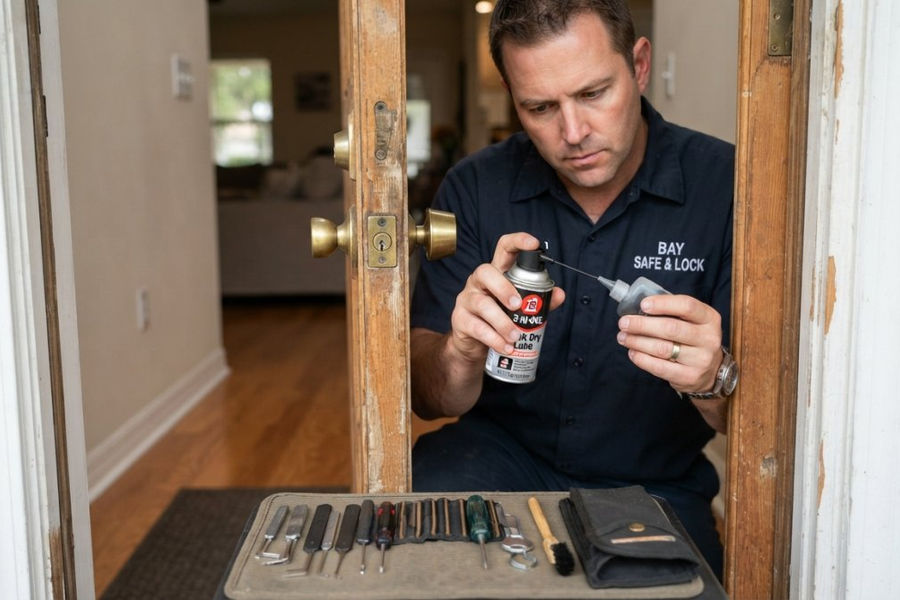


Table of Contents

  • Understanding Types of Residential Lock Failures

    • Identifying a Jammed Lock

    • Recognizing a Broken Key Inside the Cylinder

    • Detecting Internal Mechanical Failure

  • How to Fix a Jammed Door Lock: Immediate Steps

    • Tools You'll Need

    • Step-by-Step Troubleshooting

  • Removing a Broken Key from the Lock Cylinder

  • Security Risks When Your Lock Is Broken

  • Temporary Door Security Solutions

  • Residential Lock Replacement Cost and Options

    • Replacing Lock Components vs. Full Lockset

    • When to Call a Professional Locksmith

  • Legal Considerations for Gaining Entry

  • Frequently Asked Questions

Last Updated: September 30, 2026

Understanding Types of Residential Lock Failures

Residential lock breaks can happen in different ways. Each type requires a different solution. Understanding what went wrong is the first step to fixing it safely.

The most common failures fall into three categories: jammed locks, broken keys stuck inside, and internal mechanical damage. Knowing which one you're dealing with saves time and prevents you from making things worse.

Identifying a Jammed Lock

A jammed lock is stuck but still intact. The key won't turn smoothly, or it won't turn at all. You might feel resistance when you push the key in or try to rotate it.

Common causes include:

  • Dirt and debris buildup inside the cylinder

  • Rust from moisture exposure

  • Misaligned door frame putting pressure on the lock

  • Dried lubricant that's become sticky

The good news: a jammed lock can usually be fixed without professional help. The cylinder itself isn't damaged yet.

Recognizing a Broken Key Inside the Cylinder

A broken key leaves part of itself stuck in the lock. You'll see a piece of the key shaft protruding from the keyway, or the key may have snapped completely inside.

This creates an immediate problem: you can't insert another key until the broken piece is removed. Trying to force another key in will damage the cylinder further.

Detecting Internal Mechanical Failure

Internal failure means the lock's tumbler pins, springs, or cylinder are damaged. Signs include:

  • Key turns but the deadbolt doesn't move

  • Lock feels loose or wobbly inside the door

  • Bolt sticks or binds when you operate the handle

  • Key turns freely with no resistance (springs may be broken)

Internal damage usually requires full lock replacement. Repair isn't practical once the mechanism is compromised.

How to Fix a Jammed Door Lock: Immediate Steps

Most jammed locks respond to simple troubleshooting. You can try these methods before calling a professional locksmith.

Infographic demonstrating the process to fix residential lock breaks using lubricant and tools on a door cylinder

Tools You'll Need

You probably have most of these at home:

  • Graphite powder (pencil shavings work in a pinch)

  • Silicone-based lubricant spray

  • Small flashlight or headlamp

  • Paper towels or cloth

  • Toothpick or small wire (for cleaning out debris)

Avoid WD-40 or oil-based lubricants. They attract dirt and make the problem worse over time.

Step-by-Step Troubleshooting

Step 1: Clean the keyway (5 minutes)

Shine a light into the lock opening. Look for visible dirt, rust, or debris. Use a toothpick or small wire to gently remove loose material. Don't force anything.

Step 2: Apply graphite powder (3 minutes)

Step 3: Try the key again (1 minute)

Step 4: Use silicone lubricant spray (3 minutes)

Step 5: Wait and try again (varies)

Removing a Broken Key from the Lock Cylinder

A broken key stuck in the lock is frustrating, but removal is usually straightforward if you work carefully.

What NOT to do:

  • Don't drill the lock yourself unless you're comfortable with power tools

  • Don't hammer or apply heavy force

  • Don't try to push the broken piece deeper

How to extract it:

  1. Use a key extractor tool (best option)

    • Insert the extractor into the keyway above the broken key piece

    • Gently hook the extractor under the key fragment

    • Slowly pull the extractor and key piece out together

    • Key extractors cost a few dollars and work reliably

  2. Try tweezers or needle-nose pliers

    • If part of the key protrudes from the lock, grab it directly

    • Pull straight out with steady, even pressure

    • Don't twist or wiggle, which can break the fragment further

  3. Use a thin saw blade or hacksaw blade

    • Insert the blade alongside the key piece

    • Gently work it under the fragment

    • Lift carefully to remove the piece

Security Risks When Your Lock Is Broken

A broken lock is a security breach. Your home's entry point is compromised until it's fixed.

Here's what's at risk:

Immediate dangers:

  • Anyone with basic tools can manipulate or force the lock open

  • The door frame may be vulnerable if the lock mechanism is damaged

  • You have no way to secure the door if the deadbolt won't engage

Longer-term concerns:

  • Burglars target homes with visible lock damage

  • Insurance may not cover theft if the lock was known to be broken

  • A jammed lock that finally gives way might leave the door unsecured

What to do right now:

  • Use a temporary security measure (see next section) until the lock is repaired

  • Don't advertise the problem to neighbors or on social media

  • If you're renting, notify your landlord immediately, they're responsible for providing secure locks

Temporary Door Security Solutions

While you arrange a permanent fix, you need to secure the door. These temporary measures aren't perfect, but they add a layer of protection.

Door wedge or stopper

  • A rubber or metal wedge under the door prevents it from opening

  • Works from the inside only

  • Inexpensive and effective for interior doors

Portable door lock or travel lock

  • Slide-bolt locks that don't require installation

  • Cost under $20 and work on most doors

  • Easy to remove when the permanent lock is fixed

Sliding chain or bar lock

  • Installs in minutes with self-adhesive strips

  • Allows the door to open slightly without full entry

  • Good for renters since it's removable

Bracing the door

  • Lean a sturdy chair or furniture against the door from inside

  • Not foolproof, but it slows down forced entry

  • Combine with other methods for better security

Security camera or alarm sign

  • A visible camera or alarm system deters casual intruders

  • Even a dummy camera can help

  • Pair with actual security measures for real protection

Motion-activated light

  • Exterior lighting makes the entry less attractive to burglars

  • Costs $20-40 to install

  • Improves visibility for you and neighbors

Residential Lock Replacement Cost and Options

When a residential lock breaks beyond repair, replacement is the next step. You have choices about what gets replaced and how much to spend.

Replacing Lock Components vs. Full Lockset

A lockset includes the exterior knob or lever, interior hardware, and the lock cylinder. You can replace just the cylinder or the entire lockset.

Replace the cylinder only

  • Cost is lower (varies by lock type and security level)

  • Takes 10-15 minutes if you're comfortable with basic tools

  • Best option if the door hardware is still good

Replace the full lockset

  • New exterior and interior handles plus lock mechanism

  • Costs more but gives you a complete upgrade

  • Better if the door hardware is old or damaged

  • Recommended when upgrading to a higher security level

Keyed vs. keyless entry

  • Traditional keyed locks are affordable and reliable

  • Keyless locks (code, biometric, smart) cost more but add convenience

  • Smart locks integrate with home security systems

When to Call a Professional Locksmith

Some situations require professional help. Knowing when to call saves money and prevents damage.

Call a locksmith if:

  • The broken key is stuck deep in the cylinder and you can't remove it

  • The lock mechanism is damaged and won't operate at all

  • You need a lock extracted from the door without damaging the frame

  • You want to rekey locks to match existing keys in your home

  • You need a master key system (common for property managers)

  • The door frame is damaged or misaligned

  • You need a high-security lock installed

Why professionals matter:

  • They have specialized tools to remove broken keys without damage

  • They can assess whether the cylinder or full lockset needs replacement

  • They install locks correctly to ensure proper function

  • Licensed locksmiths are bonded and insured (important for home security)

Legal Considerations for Gaining Entry

If you're locked out of your own home because the lock is broken, you have legal options for entry. Understanding them prevents legal problems.

Your rights as the homeowner:

  • You can hire a locksmith to open your own door

  • You can call a locksmith to remove a broken lock and install a new one

  • You can use reasonable force to enter your own home if there's an emergency (fire, medical crisis, etc.)

What you cannot do:

  • You cannot enter a rental property without the landlord's permission (even if you're locked out)

  • You cannot damage the door or frame beyond what's necessary for entry

  • You cannot trespass on a neighbor's property to access your home

If you're renting:

  • Contact your landlord immediately, they must provide access to your home

  • Document the broken lock with photos and written notice

  • The landlord is responsible for repairs and costs

  • Do not hire a locksmith without landlord approval unless it's a genuine emergency

If you're locked out and it's an emergency:

  • Call 911 if there's a fire, medical emergency, or safety threat

  • Police can assist with emergency entry in genuine situations

  • Document the emergency and your actions

Frequently Asked Questions

Can I fix a broken residential lock myself?

Minor issues like jammed locks may respond to lubrication or cleaning, but broken internal components, extracted keys, or damaged lock barrels typically require professional attention. Attempting extraction on a broken key risks pushing fragments deeper into the cylinder. If the lock is your primary entry point, professional repair ensures security and proper function. For non-critical locks, temporary measures work until replacement.

What should I do if my key breaks inside the lock?

Stop turning immediately to avoid pushing the fragment deeper. Do not attempt to extract it with pliers or tweezers, which can damage the lock barrel further. Apply graphite powder or lock lubricant around the keyway to reduce friction, then contact a professional locksmith. Key extraction requires specialized tools and expertise to preserve the lock mechanism.

How much does residential lock replacement cost?

Costs depend on lock type, brand, complexity, and whether you replace individual components or the entire lockset. Basic deadbolts cost less than high-security models. Professional installation fees vary by location and urgency. For an accurate estimate tailored to your specific lock and situation, contact a licensed locksmith for a quote.

How do I secure my home if the lock is broken?

Use temporary security solutions immediately: install a door wedge or stopper, add a portable door lock or chain, use a portable door brace, or place a security bar across the frame. These buy time until professional repair or replacement. For overnight security, consider staying elsewhere or having someone monitor the entry. Avoid advertising the broken lock on social media.

NEED AN ESTIMATE FOR YOUR PROJECT? CLICK HERE


Rosemary M.

Dan from Bay Safe - great worker, highly professional and super intelligent!!!

Adam G.

Had my safe opened and repaired in no time flat. Very satisfied with their professionalism.

Anthony R.

I can tell you've been doing this for a long time.
Bay Safe & Lock QR code

        Hello, from Bay Safe & Lock

My wife, Hayley and daughters, Jane and Eden. Our faith and values inspire a strong desire to serve others with excellence. A daily prayer in our home is that the Lord would bless us with grace, success and prosperity in direct proportion to our integrity. 

​Colossians 3:23

bottom of page