top of page

Table of Contents

  • What Drives Emergency Locksmith Service Pricing

    • Service Call Fees vs. Labor Costs

    • Time of Day and After-Hours Surcharges

  • Residential vs. Commercial Lockout Fees

  • How to Spot a Locksmith Scam

    • Red Flags in Pricing and Communication

    • Verifying Credentials and Licensing

  • What to Ask a Locksmith Before They Arrive

  • Emergency Lockout Service Duration and Response Times

  • Understanding Your Invoice

    • Itemized Breakdown and Hidden Fees

    • Insurance and Warranty Coverage

  • Frequently Asked Questions

Last Updated: September 26, 2026

What Drives Emergency Locksmith Service Pricing

Understanding emergency locksmith pricing requires knowing the core components that make up your final bill. When you're locked out at midnight or facing a security breach, the cost reflects more than just the technician's time. Service call fees, labor rates, dispatch charges, and after-hours surcharges all stack together to create the total you'll pay.

Emergency locksmith pricing isn't arbitrary. It's built on legitimate business costs: technician training and certification, vehicle maintenance, insurance coverage, and the overhead of maintaining 24/7 availability. The difference between a standard appointment and an emergency call often justifies the premium you're charged.

Service Call Fees vs. Labor Costs

A service call fee is separate from labor costs. This is where confusion often starts. The service call fee, sometimes called a dispatch fee or trip charge, covers the locksmith's arrival at your location. It's a flat rate that exists regardless of how long the work takes. Labor costs, by contrast, are typically hourly or based on the specific job complexity.

Think of it this way: the service call fee gets the technician to your door. Labor costs are what you pay while they're working. A straightforward residential lockout might take 15 minutes of actual work, but you're paying for the dispatch, the vehicle, the equipment, and the expertise that made that 15-minute resolution possible.

Labor rates vary widely depending on lock complexity, whether the work is residential or commercial, and the technician's experience level. A simple key extraction might be a flat rate. A master key system installation for an apartment complex involves hourly labor plus materials.

Pro Tip Before calling, ask specifically: "What is your service call fee, and how is labor calculated?" This single question prevents most billing surprises. Get both numbers in writing or recorded if possible.

Time of Day and After-Hours Surcharges

After-hours service carries a premium. If you're locked out at 2 a.m., you're not just paying for the work, you're paying for the locksmith to be available when most businesses are closed. This after-hours surcharge can double or triple the base service call fee.

Weekend and holiday rates operate on the same principle. A locksmith who staffs technicians on Sunday is incurring higher labor costs than one operating Monday through Friday. That cost gets passed to you. Some locksmiths charge flat after-hours premiums. Others apply percentage-based surcharges on top of the base rate. Neither approach is inherently unfair; they're just different ways of pricing availability.

The timing matters more than you might think. A lockout at 6 p.m. on a Friday costs more than 6 a.m. on a Tuesday, even if the job itself is identical. Some locksmiths have tiered pricing: moderate surcharge for early evening, higher surcharge for late night, highest for middle-of-the-night emergencies. Others use simple day/night splits.

Understanding this structure helps you make strategic decisions. If you can wait until morning, you'll pay significantly less. If the lockout is genuinely urgent, you're locked out of your business during operating hours, for example, the after-hours premium is irrelevant because you're calling during standard business hours.

Residential vs. Commercial Lockout Fees

Residential lockouts and commercial lockouts have different pricing structures because they involve different risks and complexities. A residential lockout typically involves a single lock on a single property. A commercial lockout might involve multiple access points, security systems, and liability concerns that justify higher rates.

The work for residential lockouts is often straightforward: gain entry, verify ownership, and resolve the situation. Most residential customers are homeowners dealing with a one-time emergency.

Commercial lockouts carry higher stakes. A restaurant locked out during dinner service is losing revenue by the minute. An office building with employees unable to access their workspace creates liability and disruption. Commercial locksmiths factor in the urgency, the potential for follow-up work, and the complexity of commercial-grade locks and security systems.

Additionally, commercial properties often have master key systems, restricted key blanks, and integrated security hardware that requires specialized knowledge. A technician working on a commercial lock might need to coordinate with building management, verify access credentials, and ensure compliance with security protocols. That complexity drives pricing up.

Industrial lockouts, think manufacturing facilities or secure storage areas, sit even higher on the pricing scale. Industrial-grade locks, safes, and security systems require specialized training and equipment. The cost reflects that expertise.

When requesting a quote, specify whether the lockout is residential or commercial. The difference in pricing can be substantial, and it's based on legitimate differences in the work involved.

How to Spot a Locksmith Scam

Scams in the locksmith industry exist because emergency situations make people vulnerable. When you're locked out, you want fast resolution, and scammers exploit that urgency. Knowing what to watch for protects you from inflated charges and unethical practices.
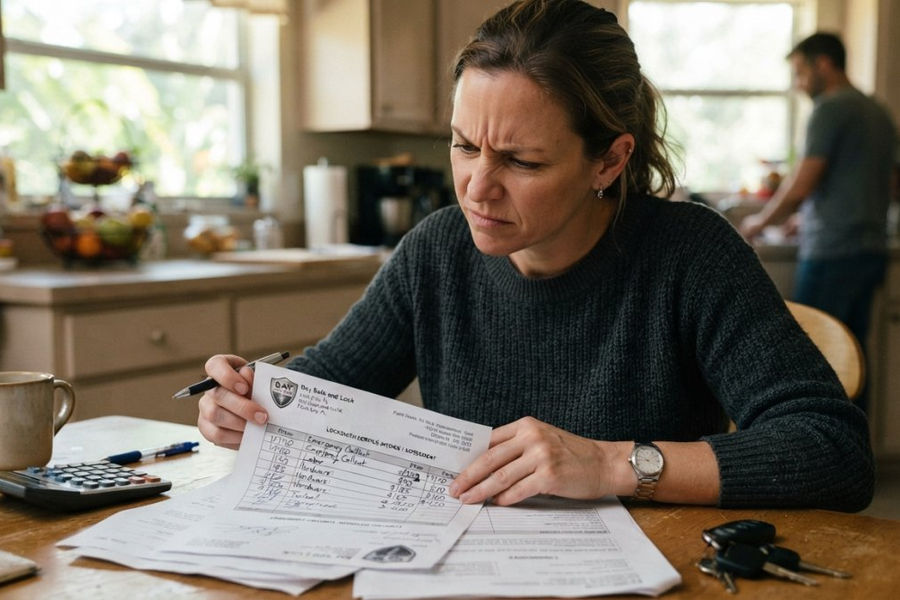
Close-up of a homeowner reviewing a locksmith invoice and contract at a kitchen table, examining paperwork with a skeptical expression

Red Flags in Pricing and Communication

A legitimate locksmith provides pricing information before arriving or immediately upon arrival. If a locksmith refuses to quote a price until they assess the lock, that's a warning sign. Legitimate professionals know their service call fees and can estimate labor costs based on lock type.

Bait-and-switch pricing is common. A locksmith quotes one price over the phone, then dramatically increases it on-site, claiming the lock is more complex than expected. While lock complexity does vary, a professional should have caught that during the phone consultation. If the price jumps from $85 to $300 after arrival, you're likely being scammed.

Watch for locksmiths who pressure you to pay cash only or who refuse to provide itemized invoices. Legitimate businesses accept multiple payment methods and provide documentation of charges. An invoice should list the service call fee, labor time and rate, materials used, and any surcharges.

Unsolicited calls offering locksmith services are almost always scams. If you didn't call them, they likely aren't a real locksmith service. Real locksmiths don't cold-call homes offering emergency services.

Another red flag: a locksmith who wants to replace your lock instead of opening it. Legitimate locksmiths can open most residential locks without damage. If replacement is truly necessary, they should explain why and provide options. If they immediately jump to "we need to drill it out and install a new lock," get a second opinion.

Watch Out If a locksmith arrives and immediately starts drilling or destructive entry without attempting non-destructive methods first, stop them and ask for an explanation. Damage-free entry is standard practice for professionals. Unnecessary destruction suggests either incompetence or intentional damage to inflate the bill.

Verifying Credentials and Licensing

Before calling, verify that a locksmith is licensed. Licensing requirements vary by state, but most states require locksmiths to be licensed and insured. Check your state's licensing board or the Better Business Bureau for verification.

Ask for proof of insurance when the locksmith arrives. Legitimate locksmiths carry liability insurance. If they can't provide proof, decline their services. Insurance protects you if something goes wrong.

Federal background checks are a mark of professionalism.

What to Ask a Locksmith Before They Arrive

Asking the right questions during your initial call prevents surprises and helps you identify legitimate professionals. These questions serve as a screening mechanism.

Emergency Lockout Service Duration and Response Times

Emergency response time varies based on location, time of day, and current demand. Understanding realistic timeframes helps you plan and avoid overpricing based on false urgency.

Understanding Your Invoice

Your invoice is your protection against overcharging. A legitimate invoice breaks down charges clearly so you understand what you're paying for.

Itemized Breakdown and Hidden Fees

A proper invoice lists:

  • Service call fee (the flat dispatch charge)

  • Labor time and hourly rate (or flat labor fee for the specific job)

  • Materials used (if any, keys, lock parts, etc.)

  • Any surcharges (after-hours, weekend, emergency)

  • Total amount due

Each line item should be clear. "Labor: $150" is acceptable if that was the quoted rate. "Miscellaneous charges: $200" is not. You should understand every charge.

Key Takeaway The difference between a fair locksmith and a scammer often comes down to transparency. Legitimate professionals provide clear pricing upfront, itemize invoices, and stand behind their rates. Scammers avoid these practices.

Insurance and Warranty Coverage

Ask whether a warranty applies to your job.

Insurance coverage matters if damage occurs during the work. Your homeowner's or business insurance might cover locksmith-related damage, but it depends on your policy. Some locksmiths carry insurance that covers accidental damage they cause. Verify this before work begins.

Frequently Asked Questions

What is a standard service call fee for emergency locksmith services?

Service call fees vary based on time of day, location, and lock complexity. Most locksmiths charge a dispatch or trip charge separate from labor costs. For emergency locksmith service pricing, fees are typically higher during nights, weekends, and holidays. Contact Bay Safe and Lock for a current quote tailored to your specific situation and property type.

How can I tell if a locksmith quote is legitimate?

A legitimate locksmith should provide an upfront estimate before beginning work, explain what's included in the service call fee, and show proof of licensing and insurance. Ask for references and verify credentials through your state's licensing board. Be wary of quotes that seem unusually low or locksmiths who pressure you into immediate payment without itemizing charges.

What factors influence the final cost of an emergency lockout service?

Key factors include the type of lock (residential deadbolt vs. commercial security hardware), time of day (after-hours surcharge), location and travel distance, lock complexity and manipulation difficulty, and whether hardware replacement is needed. Emergency response times and dispatch fees also affect pricing. Professional assessment on-site may reveal additional costs if rekeying or hardware replacement is necessary.

Does insurance typically cover emergency locksmith services?

Most homeowners insurance policies do not cover lockout services unless break-in or property damage occurred. Some renters insurance may include limited coverage. Check your specific policy terms and contact your insurance provider. Commercial property policies sometimes include emergency access services. Always ask your locksmith about warranty coverage on their work.

What should I ask a locksmith before they arrive to avoid surprises?

Ask for an estimated arrival time, confirm the service call fee structure, inquire about their hourly labor rate if applicable, request an upfront quote for the specific service needed, and ask whether additional charges may apply if the lock requires special techniques or hardware replacement. Also verify they're licensed, insured, and offer damage-free entry methods before authorizing work to begin.

NEED AN ESTIMATE FOR YOUR PROJECT? CLICK HERE


Table of Contents

  • 1. Install High-Security Commercial Locks

  • 2. Deploy Security Camera Installation and Surveillance

  • 3. Implement Commercial Access Control Systems

  • 4. Strengthen Perimeter Security and Lighting

  • 5. Establish Employee Security Protocols and Training

  • 6. Protect Digital Assets and Customer Data

  • 7. Secure Your Business Storefront With a Comprehensive Security Audit

  • Frequently Asked Questions

Last Updated: September 25, 2026

When a storefront sits empty at night, it becomes a target. Break-ins, theft, and vandalism cost retail businesses thousands in losses and recovery time. The difference between a vulnerable entrance and a secure one often comes down to whether you've implemented layered protection strategies. At Bay Safe and Lock, we've spent over a decade helping business owners in Plant City fortify their storefronts against criminal activity. Here's how to secure business storefront effectively using proven physical and digital security measures.

Quick Overview

Securing a business storefront requires a multi-layered approach that combines physical barriers, surveillance, access control, and employee protocols. The most effective strategies address vulnerabilities from multiple angles simultaneously rather than relying on a single solution.

1. Install High-Security Commercial Locks

The foundation of storefront security starts at the door. Standard locks are not enough, they're easily bypassed by someone with basic tools. High-security commercial locks use reinforced materials and complex internal mechanisms that resist picking, drilling, and forced entry.

When you upgrade to high-security commercial locks, you're adding significant friction to a criminal's entry point. These locks feature hardened steel pins, restricted keyways, and bump-resistant designs. The best installations pair the lock itself with reinforced strike plates that are bolted directly into the door frame, not just surface-mounted.

Bay Safe and Lock specializes in selecting and installing commercial-grade hardware tailored to your specific storefront layout. A proper installation means the lock's strength extends through the entire entry assembly, not just the mechanism itself. This prevents attackers from simply kicking in a door that has a good lock but a weak frame.

Professional locksmith installing a commercial-grade deadbolt into a reinforced strike plate on a storefront metal door, showing close-up detail of the hardened steel mechanism

Master key systems are another critical component. If you manage multiple entry points or have staff who need access to different areas, a master key system allows you to control access hierarchy without duplicating keys indiscriminately. This prevents unauthorized copying and limits exposure if a key is lost.

Pro Tip Rekeying existing locks is far cheaper than replacing hardware entirely. When staff turnover happens or keys go missing, rekeying changes the internal pin configuration so old keys no longer work. Bay Safe and Lock can rekey your entire storefront in a single service call.

2. Deploy Security Camera Installation and Surveillance

Surveillance serves two purposes: it deters criminals who know they're being recorded, and it provides evidence if a crime does occur. A visible camera system signals that your storefront is monitored, which alone pushes many criminals toward easier targets.

Effective security camera installation for a storefront requires cameras positioned to cover entry points, the sales floor, and the register area. High-definition cameras with night vision capability capture usable footage even in low light. The camera placement matters as much as the camera quality, a poorly positioned camera captures an angle that misses the criminal's face or the point of entry.

Cloud monitoring and real-time alerts mean you can respond to suspicious activity immediately, even when you're not on-site. Modern surveillance systems send notifications to your phone when motion is detected during off-hours or when someone approaches a door. This allows faster police response and can prevent a break-in from escalating into a full theft.

Watch Out Surveillance footage is only useful if it's stored securely and retained long enough. Criminals sometimes target the DVR or storage device itself. Ensure your system backs up footage to an offsite cloud server with encryption so that even if on-site equipment is stolen, the evidence remains intact.

Storage redundancy and encryption protect your surveillance data. If footage is stored only on local hardware, a thief can destroy evidence by removing the DVR. Encrypted cloud backup ensures that even if your on-site system is compromised, law enforcement has access to recorded evidence.

3. Implement Commercial Access Control Systems

Access control systems go beyond locks, they track who enters your storefront, when they enter, and what areas they access. For multi-unit properties or businesses with restricted areas, this level of control is essential.

Biometric authentication and card-based access systems replace traditional keys with credentials that can be revoked instantly. If an employee leaves, you don't need to rekey locks, you simply deactivate their access card or remove their biometric profile. This prevents the common problem of former employees or contractors retaining key access indefinitely.

Modern commercial access control systems integrate with surveillance. When someone swipes a card or enters a code, the system logs the timestamp and can cross-reference it with camera footage. This creates accountability and makes it nearly impossible for someone to deny they were present at a specific time.

For retail storefronts with back-office areas or inventory storage, access control restricts entry to authorized personnel only. This reduces internal theft and ensures that only trained staff handle sensitive areas like the register or product storage.

4. Strengthen Perimeter Security and Lighting

The perimeter is your first line of defense. Hardened entry points, reinforced windows, and strategic lighting all work together to make your storefront a harder target than neighboring businesses.

Motion-activated lighting around your storefront entrance and loading areas eliminates dark hiding spots where criminals can work unobserved. Bright lighting makes criminal activity visible to passersby and increases the risk of being caught. Most criminals avoid well-lit areas because the exposure increases their chance of identification.

Window security film reinforces glass and makes it harder to smash through. While it won't stop a determined attacker, it slows them down and increases noise, which draws attention. Reinforced window frames and security bars on ground-level windows are standard in high-theft retail environments.

Door reinforcement goes beyond the lock. Solid core or metal doors resist kicking better than hollow-core doors. Door frame reinforcement with strike plates bolted into the structural frame prevents the door from being forced open even if the lock is compromised.

Best For Storefronts in high-traffic areas benefit most from visible perimeter hardening. When potential criminals see reinforced doors, security cameras, and bright lighting, they move to easier targets nearby.

5. Establish Employee Security Protocols and Training

Your employees are either your strongest security asset or your biggest vulnerability. A well-trained staff follows security protocols consistently, recognizes suspicious behavior, and responds to incidents appropriately.

Security protocols should cover cash handling, after-hours procedures, and suspicious customer behavior. Employees should know how to secure the storefront before leaving, what to do if they notice signs of tampering, and when to contact management or law enforcement.

Employee training reduces internal theft, which accounts for significant inventory shrinkage in retail. Clear procedures about who can access the register, how transactions are logged, and how inventory is tracked make it harder for staff to steal without detection.

For after-hours security, establish clear closing procedures. Every employee should follow the same checklist: verify all doors are locked, arm the alarm system, and confirm the building is empty. Consistency prevents the common mistake of someone leaving a door unlocked or forgetting to arm the system.

6. Protect Digital Assets and Customer Data

Your storefront's digital infrastructure is as important as its physical security. Customer payment data, business records, and employee information all require protection against cyber threats.

Encryption of data-at-rest and data-in-transit ensures that even if someone gains unauthorized access to your systems, the information remains unreadable. SSL certificates on your website signal to customers that their payment information is secure and encrypted during transmission.

Multifactor authentication on all admin accounts prevents unauthorized access even if a password is compromised. When employees access the register system, inventory management, or business records, multifactor authentication adds a second verification step that makes account takeover significantly harder.

Endpoint protection and vulnerability scanning identify weaknesses in your systems before criminals exploit them. Regular security audits catch misconfigurations, outdated software, and unpatched vulnerabilities that create entry points for attackers.

Pro Tip Your payment processor and point-of-sale system should be PCI DSS compliant (PCI Security Standards Council). This compliance standard ensures that systems handling credit card data meet minimum security requirements. Shopify and similar platforms handle much of this compliance automatically, but you remain responsible for your own system security.

7. Secure Your Business Storefront With a Comprehensive Security Audit

The best way to identify gaps in your current security is to conduct a comprehensive security audit. A professional assessment evaluates your physical security, access control, surveillance, and data protection to create a prioritized improvement plan.

A security audit examines your entry points, lighting, camera coverage, lock quality, and employee procedures.

Security Layer

Primary Benefit

Implementation Complexity

High-security locks

Prevents forced entry at the door

Low to moderate

Surveillance system

Deters criminals and provides evidence

Moderate

Access control

Tracks entry and restricts unauthorized access

Moderate to high

Perimeter hardening

Eliminates easy entry points

Low to moderate

Employee training

Reduces internal theft and ensures protocol compliance

Low

Data protection

Protects customer and business information

Moderate to high

Security audit

Identifies gaps and prioritizes improvements

One-time assessment

Frequently Asked Questions

What are the most effective physical security measures for a retail storefront?

The most effective measures combine high-security commercial locks, surveillance systems, motion-activated lighting, and hardened entry points. Start with commercial-grade deadbolts and reinforced door frames, add visible cameras to deter theft, install perimeter lighting to eliminate dark entry areas, and consider access control systems for restricted zones. A professional security audit identifies gaps specific to your storefront layout and inventory value.

How can commercial access control systems improve storefront security?

Commercial access control systems replace traditional keys with credential-based entry (keycards, biometric authentication, or PIN codes) that log every access attempt in real-time. This prevents unauthorized key duplication, restricts employee access to specific areas, and creates an audit trail for incident response. If theft or a data breach occurs, you can identify exactly who accessed restricted zones and when, supporting both loss prevention and liability defense.

How often should I audit my storefront security setup?

Conduct a formal security audit annually or whenever staffing changes, inventory composition shifts, or after a security incident. Between audits, review surveillance footage regularly, test alarm systems monthly, and update access control permissions whenever employees join or leave. This ongoing vigilance catches vulnerability gaps before criminals exploit them and ensures your security infrastructure stays aligned with your current business operations.

What role do security cameras play in deterring storefront theft?

Visible security cameras act as a psychological deterrent, signaling that theft will be recorded and traceable. They also provide real-time monitoring and recorded evidence for incident response and law enforcement. High-definition surveillance footage helps identify suspects, recover stolen inventory, and support insurance claims. Cameras positioned at entry points, checkout areas, and high-value inventory zones maximize both deterrent effect and evidentiary value.

NEED AN ESTIMATE FOR YOUR PROJECT? CLICK HERE


Table of Contents

  • What Happens When You Lose All Your Safe Keys

  • Contacting the Manufacturer for Key Replacement

  • Safe Opening Services and Professional Recovery

  • Non-Destructive Entry Methods

  • How to Replace Lost Safe Keys

  • Cost to Hire a Locksmith for a Safe

  • Security and Warranty Considerations

  • Frequently Asked Questions

Last Updated: September 24, 2026

What Happens When You Lose All Your Safe Keys

Losing all your safe keys creates an immediate access problem, but it's solvable. Professional recovery methods exist for most safes.

Don't force the safe open, forced entry damages the lock mechanism and can destroy contents.

Most safes can be opened without damage using professional methods. The right approach depends on your safe's type and specifications.

Recovery depends on the safe's age, lock type, fire-rating, and proof of ownership. Understanding your options helps you choose the best approach.

Contacting the Manufacturer for Key Replacement

The manufacturer is often your best first step. They maintain records and can verify ownership to replace lost safe keys.

Locate your safe's serial number (typically stamped on the door or frame) before contacting the manufacturer.

Contact the manufacturer with your serial number and proof of ownership (receipt, warranty card, or registration).

After verification, the manufacturer will provide a key code or replacement keys. Turnaround typically ranges from days to weeks.

Costs vary by manufacturer. Request a quote before proceeding.

Ask about all costs upfront, including shipping and verification fees.

Safe Opening Services and Professional Recovery

Professional safe technicians have specialized tools and expertise to open most safes without destruction.

Professional locksmith using specialized tools to carefully open a safe lock mechanism, wearing safety credentials and work gloves in a secure facility

Technicians use non-destructive methods (lock manipulation, specialized picks, or other techniques) to preserve function. A skilled technician often opens a safe in under an hour.

Find a licensed locksmith with safe opening experience, insurance, and positive customer references.

The technician will assess your safe's lock type, condition, and history before quoting a price.

Pricing depends on lock complexity and type. Simple mechanical locks cost less than electronic ones; fire-rated safes cost more due to longer opening times.

Bring identification and ownership documentation when hiring a professional, this protects both parties.

Non-Destructive Entry Methods

Non-destructive entry preserves your safe and contents. Success depends on lock type; mechanical and electronic locks require different approaches.

Welding and stuff

Mechanical Lock Recovery

For traditional key-cylinder locks, technicians use three primary non-destructive techniques:

Manipulation works by feeling for internal pins to set at the shear line. This silent, mark-free method works on most safes manufactured before 2010, typically taking 15 to 45 minutes depending on lock complexity.

Lock picking uses specialized picks to manipulate pins individually. Slower than manipulation (30 minutes to two hours), it works on locks resistant to manipulation.

Bypass techniques exploit manufacturer-built overrides (master keys, factory resets, emergency keyholes). This is the fastest non-destructive route when available, taking 10 to 20 minutes.

Modern high-security locks with anti-picking features (security pins, serrated pins) may resist non-destructive entry.

Electronic Lock Recovery

Electronic keypads and digital locks follow a completely different recovery path:

Password reset is possible if the keypad powers on. The technician may attempt factory defaults or contact the manufacturer for the master code. If successful, the safe opens in minutes.

Battery replacement solves many electronic lock failures. If the keypad is unresponsive, a dead battery is often the cause. This is non-destructive and costs nothing if you provide batteries.

Manufacturer assistance is often necessary for electronic locks. If the keypad is damaged or code unknown, the manufacturer must provide a reset procedure. This requires proof of ownership and typically takes 24 to 72 hours.

If the circuit board is damaged or the manufacturer is out of business, electronic recovery may require drilling.

Fire-Rated Safes: Special Considerations

Fire-rated safes contain insulation between walls. Non-destructive entry is critical because drilling or forced manipulation compromises fire rating. Discuss this with your technician before work begins.

When Non-Destructive Entry Isn't Possible

Advanced security locks (biometric, dual-authentication, military-grade) may require drilling. The technician drills out the lock and replaces it, preserving structural integrity and contents. Expect higher costs for drilling and lock replacement.

How to Replace Lost Safe Keys

Once your safe is open, you'll need replacement keys. The process depends on your safe's lock type and manufacturer.

For key-only locks, the manufacturer provides replacement keys. You'll need your safe's key code. The manufacturer stamps this code on your original keys or documentation. If you have the code, ordering replacements is straightforward.

Contact the manufacturer with your key code. They'll create new keys matching the original specification. Turnaround typically takes one to two weeks. Cost is usually modest, often under fifty dollars for a set.

For combination locks, you don't need a physical key. But if you've lost the combination, you'll need to reset it. A safe technician can help with this. They'll open the safe and help you set a new combination.

For electronic locks, the process varies. Some allow password resets if you have proof of ownership. Others require the manufacturer's assistance. A technician can guide you through the specific steps for your model.

When ordering replacement keys, order extras. Keep them in separate secure locations. This prevents a repeat of your current situation. Some people give a spare to a trusted family member or keep one in a safety deposit box.

Document your key code or combination in a secure way. Write it down and store it somewhere safe. A locked drawer, safety deposit box, or secure digital vault all work. Don't store it where someone could easily find it.

Cost to Hire a Locksmith for a Safe

Professional safe opening costs vary widely, but understanding the pricing structure helps you budget and know when to seek multiple quotes.

Typical Price Ranges

Non-destructive opening of a standard mechanical lock typically ranges from $150 to $400. This covers simple manipulation or picking of older safes with basic locks. Electronic lock recovery (password reset or battery replacement) usually costs $100 to $300 if the manufacturer code is available or the battery is the issue.

If drilling is necessary, expect $300 to $800 or more. Drilling requires specialized equipment, takes longer, and often includes lock replacement. Fire-rated safes cost more to drill because the process is slower and requires careful technique to avoid damaging the insulation.

After-hours emergency service (nights, weekends, holidays) typically adds 50 to 100 percent to the base fee. A $300 job becomes $450 to $600 if you need it done at midnight on a Sunday.

Factors That Increase Cost

Lock type is the primary cost driver. A simple pin-tumbler lock (common on older safes) costs less than a high-security lock with anti-picking features. Electronic locks with damaged keypads cost more than those with a dead battery.

Safe age and condition matter significantly. Older safes with worn locks are easier to open. Safes that have been previously forced open, corroded, or damaged are harder to work with and take longer. Rust or mineral deposits inside the lock mechanism increase complexity.

Safe size and weight affect travel time and labor. A small desktop safe is quicker to work on than a 500-pound floor safe. Larger safes may require the technician to bring additional equipment or assistance.

Your location determines availability and pricing. Urban areas with multiple locksmiths have competitive pricing; rural areas may have only one or two options and higher rates. Travel fees apply if the technician must drive more than 30 minutes. Some locksmiths charge per mile; others charge a flat travel fee of $50 to $150.

Proof of ownership verification can add time if documentation is incomplete. If you lack a receipt, warranty card, or registration, the technician may need to contact the manufacturer or perform additional verification. This adds 24 to 48 hours and sometimes a verification fee of $25 to $75.

Getting Accurate Quotes

When you contact a locksmith, provide as much detail as possible: the safe's brand, model (if known), approximate age, lock type (mechanical or electronic), and current condition. Photos help. Most locksmiths offer free phone estimates based on this information.

Request a written quote before work begins. A reputable locksmith will inspect the safe and provide a binding estimate. This protects you from surprise charges. Ask whether the quote includes lock replacement (if drilling is necessary) and whether the technician accepts payment plans or credit cards.

Get at least two quotes. Prices vary by technician and region. Comparing quotes helps you identify fair pricing and avoid outliers. However, the cheapest option isn't always the best, verify that the locksmith is licensed, insured, and has positive reviews.

Insurance and Warranty Coverage

Many homeowner's insurance policies cover locksmith services for safes, but coverage varies. Before paying out of pocket, contact your insurance agent and ask whether safe opening is covered. If it is, you may be able to file a claim and recover the cost, minus your deductible.

Some policies require you to use a preferred vendor or pre-approve the service. Others reimburse you after you submit a receipt.

Avoiding Unnecessary Costs

Security and Warranty Considerations

Losing all your safe keys raises security questions. Once the safe is open, you'll want to restore security. Several steps help protect your valuables.

Frequently Asked Questions

What do I do if I lost the keys to my safe?

First, locate your safe's serial number on the back or bottom panel, this is critical for proof of ownership. Contact the manufacturer with documentation proving you own the safe; they can provide replacement keys if you verify ownership. If the manufacturer cannot help, hire a professional locksmith or safe technician who specializes in non-destructive entry. Avoid forced entry or drilling unless absolutely necessary, as these methods damage the lock mechanism and may void your warranty.

Can a locksmith make a new key for a safe?

Yes, a qualified safe technician can create replacement keys through several methods. If the safe has a key code on file with the manufacturer, they can cut new blanks. For mechanical locks without a code, locksmiths use non-destructive techniques like lock picking or manipulation to access the internal lock cylinder and create new keys. This requires specialized skills and tools, so always hire a licensed professional with experience in safe recovery to avoid damage.

Is it possible to drill a safe open without damaging the contents?

Drilling is a destructive method that should only be a last resort. While it allows access to the contents inside, it permanently damages the lock mechanism and may compromise the safe's fire-rating and structural integrity. Professional safe technicians can often recover access using non-destructive techniques first, such as lock manipulation or bypass methods, before considering drilling. If drilling becomes necessary, a skilled technician can minimize internal damage, but the safe will need repair or replacement afterward.

How much does it cost to unlock a safe?

Pricing depends on several factors: the safe's lock type (mechanical vs. electronic), whether non-destructive or destructive methods are needed, the technician's travel distance, and emergency timing. Professional locksmith services for safe opening typically range based on complexity and time required. Contact a licensed safe technician for an estimate specific to your safe model and situation.

NEED AN ESTIMATE FOR YOUR PROJECT? CLICK HERE


Rosemary M.

Dan from Bay Safe - great worker, highly professional and super intelligent!!!

Adam G.

Had my safe opened and repaired in no time flat. Very satisfied with their professionalism.

Anthony R.

I can tell you've been doing this for a long time.
Bay Safe & Lock QR code

        Hello, from Bay Safe & Lock

My wife, Hayley and daughters, Jane and Eden. Our faith and values inspire a strong desire to serve others with excellence. A daily prayer in our home is that the Lord would bless us with grace, success and prosperity in direct proportion to our integrity. 

​Colossians 3:23

bottom of page